Richard Barney asks how alchemy survived the Enlightenment to influence British literature, aesthetics, and political thought. Discover how Enlightenment writers and satirists like Joseph Addison, Edmund Burke, and Mary Wollstonecraft adapted alchemical techniques like sublimation and distillation—from Isaac Newton's laboratory experiments to James Gillray's political cartoons of Prime Minister William Pitt.
John Sullivan asks, how did eighteenth-century people understand earthquakes before modern seismology? “Fractious Knowledge” examines how disasters in Italy and Guatemala brought European experts into contact with local builders, artisans, and environmental knowledge. It also shows how global networks of empire pushed natural philosophers to imagine earthquakes on an increasingly planetary scale. Early modern earthquakes shook the foundations of classical science.
For over three decades, Phunday has been the event to meet fellow historians of science, exchange ideas, and receive valuable input in a collegial atmosphere.
Emma Day explores how reproductive expectations shaped women’s healthcare in the United States. Her research reveals how medicine often linked women’s health to reproduction, while also examining the growing recognition of women’s health beyond pregnancy.
The 31st annual Artefacts conference will be hosted at the Science History Institute Monday, October 19, 2026-Wednesday, October 21, 2026
Applications must be received by October 15, 2026 to be considered for the upcoming Fall-Spring academic year.
The Science History Institute is seeking an accomplished executive to serve as Vice President and Arnold Thackray Director of the Donald F. and Mildred Topp Othmer Library of Chemical History.
The conference will take place June 21-25, 2027, at the University of Toronto, Canada. The submission deadline is November 15, 2026.
Jingwen Li uses Consortium collections to explore how ocular impairment was observed, diagnosed, and communicated in transpacific clinics from 1830 to 1930, revealing the challenges of representing vision and visual disability across medical traditions and cultural contexts.
Image
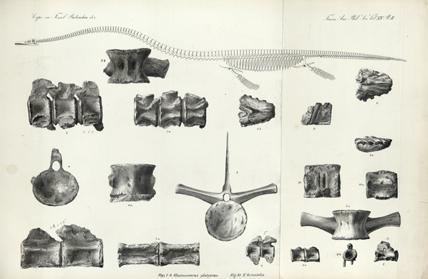
Edward Cope’s Elasmosaurus, as published in the Transactions of the American Philosophical Society, after position of the head is corrected.