The collection includes more the 97 linear feet of materials of one of the most significant American chemists of the 20th century.
Archaeology, “Cultural Resources” and Development Expertise in the United States and Brazil
Drawing on archival collections at the Smithsonian and Princeton, Adam Fertig traces the evolution of development-related archaeology from the New Deal era through the emergence of the “cultural resource management” model in the 1970s and its subsequent international circulation. By situating archaeology within histories of technical expertise, environmental governance, and the privatization of scientific knowledge, Fertig examines how scientific and social-scientific expertise was deployed both to legitimize and to contest development projects, particularly in the Brazilian Amazon, where scientists, consultants, and Indigenous activists helped shape debates over development and environmental protection.Extracting Self-Reliance: Petroleum and the Making of an Energy Regime in Modern China
Since the 1930s, China has pursued energy self-reliance (zili gengsheng 自力更生). This national project was shaped by transnational exchanges of expertise and technology, as well as by local environmental conditions. Zhongxian Xiao demonstrates that Cold War energy politics emerged not only from above, in the headquarters of governmental agencies, but also from below and underground, through the everyday life of oil towns and the hydrocarbons in the reservoir.A New Era in the Fight for Racial Equality in Nursing
In the mid-twentieth century, Philadelphia’s Mercy-Douglass Hospital School of Nursing was one of the only few Black-controlled nursing programs in the US. Hafeeza Anchrum traces the school's rise and fall to show how Black women struggled for both integration and the preservation of their own institutions of learning.All application materials are due no later than 11:59 PM CT on January 19, 2027.
The digital collections include materials relevant to the history of medicine and the history of technology in Japan.
The physicist and linguist was a pioneer in speech acoustics and phonology.
The collections include materials on ornithology, environmental monitoring related to the Three Mile Island nuclear power plant accident, and women in health and medicine.
Columbia University has added several notable collections, covering broad topics including earth, computer and physical sciences, as well as institutional and philanthropic records.
Salem Elzway brings together labor history, political economy, and Science and Technology Studies to examine the history of automation in postwar America. His research traces how political and economic institutions shaped the development and use of industrial robots, from their place in labor-management relations to their role in the production and reproduction of racial difference. Drawing on extensive archival research, he connects the history of robotics to the military-industrial-academic complex, the early development of artificial intelligence, and debates over unemployment and inequality.
Caroline Wechsler uses Consortium collections to trace the evolution of clinical medical genetics in the United States during the second half of the twentieth century, focusing on Marfan syndrome and Ehlers-Danlos syndrome (EDS). Through archival research, she examines the development of medical genetics as a clinical specialty and explores how its changing boundaries shape contemporary questions of diagnosis, clinical responsibility, and patient care.
Richard Barney asks how alchemy survived the Enlightenment to influence British literature, aesthetics, and political thought. Discover how Enlightenment writers and satirists like Joseph Addison, Edmund Burke, and Mary Wollstonecraft adapted alchemical techniques like sublimation and distillation—from Isaac Newton's laboratory experiments to James Gillray's political cartoons of Prime Minister William Pitt.
John Sullivan asks, how did eighteenth-century people understand earthquakes before modern seismology? “Fractious Knowledge” examines how disasters in Italy and Guatemala brought European experts into contact with local builders, artisans, and environmental knowledge. It also shows how global networks of empire pushed natural philosophers to imagine earthquakes on an increasingly planetary scale. Early modern earthquakes shook the foundations of classical science.
Tuesday, November 24, 2026, 12:00 pm EST
Allison Bigelow
University of Toronto
Wednesday, November 25, 2026, 12:00 pm EST
Consortium Working Group
Thursday, November 26, 2026, 11:00 am EST
Consortium Working Group
Tuesday, December 1, 2026, 8:00 am EST
Consortium Working Group
Wednesday, December 2, 2026, 8:00 am EST
Consortium Working Group
Friday, December 4, 2026, 11:00 am EST
Consortium Working Group
Image
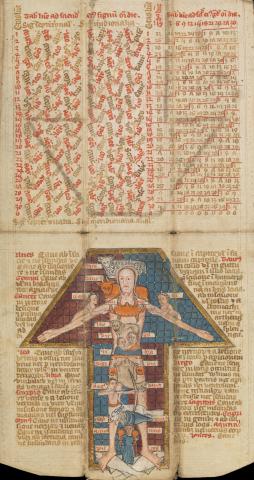
English folding almanac in Latin ca. 1415-1420.
Member Institutions
- American Institute of Physics
- American Philosophical Society
- Brown University
- California Institute of Technology
- Carnegie Mellon University
- Cold Spring Harbor Laboratory
- College of Physicians of Philadelphia
- Columbia University
- Drexel University
- Duke University
- Harvard University
- History of Science Society
- Huntington Library
- Johns Hopkins University
- Library of Congress
- Linda Hall Library
- Massachusetts Institute of Technology
- Max Planck Institute for the History of Science
- McGill University
- National Library of Medicine
- New York Academy of Medicine
- Princeton University
- Rockefeller Archive Center
- Science History Institute
- Smithsonian Institution
- United States Naval Observatory
- University of California San Francisco
- University of Illinois Urbana-Champaign
- University of Kansas
- University of Manchester
- University of Maryland-College Park
- University of Oklahoma
- University of Pennsylvania
- University of Pittsburgh
- University of Sydney
- University of Toronto
- University of Wisconsin-Madison
- Wagner Free Institute of Science
- Wellcome Collection
- Yale University