Magdalena Grüner, University of Southern California Society of Fellows in the Humanities, "On Watery Ground: Picturing Seeing in the Dark."
Historians of science have recently begun to examine role of the oceans themselves in human activity, not just as a pathway between places that matter, but as a place with a history of its own, with which humans have always interacted. In turning their gaze to the other two thirds of the earth's surface, scholars thus acknowledge the oceans as a changeable and changing place, affecting and affected by human activities. This "oceanic turn" is playing out in the humanities broadly, as scholars in many disciplines explore the role of the oceans in human endeavors including labor, culture, politics, industry, law, or literature. Spanning many different periods and regions around the world, this group will examine broad conceptions of oceans across history.
Upcoming Meetings
Tuesday, November 17, 2026, 2:00 - 3:30 pm EST
Tuesday, December 15, 2026, 2:00 - 3:30 pm EST
Morgan Hardy, University of Tennessee, paper title TBA
Tuesday, January 19, 2027, 2:00 - 3:30 pm EST
Ada Ferraresi, DEEPMED project at University of Sevilla, dissertation chapter title TBA
Tuesday, February 16, 2027, 2:00 - 3:30 pm EST
TBA
Tuesday, March 16, 2027, 2:00 - 3:30 pm EDT
TBA
Tuesday, April 20, 2027, 2:00 - 3:30 pm EDT
TBA
Tuesday, May 18, 2027, 2:00 - 3:30 pm EDT
TBA
Tuesday, June 15, 2027, 2:00 - 3:30 pm EDT
TBA
Past Meetings
-
Pedro Afonso Cristovão dos Santos, Universidade Federal da Integração Latino-Americana, "The Sargasso Sea and the 'Discovery' of the Americas: 19th Century Transnational Debates on Nautical History and Historical Geography"
-
Ali Glassie, Northeastern University, Syllabus Assessment Workshop: "Ocean Literacies"
-
Oceans HSTM Book Club: The Sequel!
Alison Glassie (Northeastern University) will lead us in a discussion of Ned Beauman's novel Venomous Lumpsucker.
The book should be available at all the usual places, and probably at your local public library.
-
We will gather informally to hear about all of our research, plans, and summer travels. Please join us!
-
Penelope K. Hardy, University of Wisconsin-La Crosse, "Science from the Quarterdeck: Naval-Scientific Networks and the 1870s Challenger Expedition"
-
Seth Stein LeJacq, Hunter College, The City University of New York, "Hidden Crimes: Sexual Violence and Historical Memory of Britain’s Navy in the Age of Sail"
-
Daniella McCahey (Texas Tech University) and Sam Robinson (University of York), "Research and Development in the Dependencies of the Falkland
Islands’: The Discovery Committee and the Early Politics of the Discovery Investigations"
-
Aijie Shi, University of Wisconsin-Madison, “The Life History of Laminaria japonica in the Northwest Pacific”
-
Aaron Van Neste, Oberlin College, "The Rise and Fall of the South African Pilchard and Anchovy Fisheries (1950-1980)"
-
Karen Pinto, University of Colorado-Boulder, “All the World’s an Island: A Taussigian Reading of Ancient, Medieval, and Early Modern Maps with an Islamicate Twist”
-
Our December meeting is cancelled. See you in January!
-
Sonya Schoenberger, Stanford University, "Enclosing the Sea: Marine Resource Sovereignty and the Rise of 'Large Ocean States' in the Postwar Pacific"
-
Scott Erich, Washington College, "The Subterranean Sea"
-
Kamil Ahsan, Yale University, "The Reef in the Oilfield: Petroleum Geology, and Oil Fetishism in Post-War British Honduras (1950-1990)"
-
Oceans Book Club! We're reading Ray Nayler's The Mountain in the Sea (2022).
Grab the book, give it a read, and join us for a discussion led by Alison Glassie (Northeastern University).
-
Publishing Roundtable!
Meet journal editors from Mainsheet, Coastal Studies & Society, The Northern Mariner, and Animal History and ask them anything about submitting your article
-
Samantha Muka, Stevens Institute of Technology, "Extending the Petroleumscape: Building the Liberty Ship Reefs in Texas Coastal Waters"
-
Antony Adler, Carleton College, "Afterlives of Interspecies Collisions: Giant Squid and Knowledge of the Sea"
-
Zi Yun Huang, University of Chicago, Dissertation Prospectus for "A History of Plankton Science from Protoplasm to Petroleum"
-
Derek Nelson, Skagit Valley College, "An Atlantic Framework for the History of Marine Borers ”
Group Conveners
Max Bridge
I am a postdoctoral fellow at Harvard University's Mahindra Humanities Center. Recently graduating from Brown University, my dissertation project - "Oceanic Listening: Sound, Cetaceans, and the History of Sensory Environments" - placed sound at the center of human-cetacean history and placed sensory experience at the center of how past environments have been known by human and nonhuman subjects. My work traces how sound shaped human, whale, and dolphin relationships across histories of whaling, science, aesthetics, and popular culture over the past 200 years. My next project will reconstruct the environmental history of disability activism in the 20th-century United States.

Penelope Hardy
Penelope K. Hardy is a historian of science, technology, and medicine and an associate professor at the University of Wisconsin-La Crosse. She studies the historical intersection of technology and the ocean sciences. Her current book project examines a series of nineteenth- and twentieth-century ocean-going research vessels and the cultures and practices surrounding their use. She is a vice president of the International Commission of the History of Oceanography, is vice president for research and publications of H-Net, and helped to found H-Oceans.
Daniella McCahey
Daniella McCahey is an Assistant Professor at Texas Tech University, where she primarily teaches on British history and the history of science. She studies the relationship between science and the environment in Polar and ocean regions. She is the co-author of Antarctica: A History in 100 Objects (Bloomsbury 2022) and the co-editor of Antarctic Materialities (Berghahn 2026).
326 Members
You must be a member to view resources. Login or create an account
Image
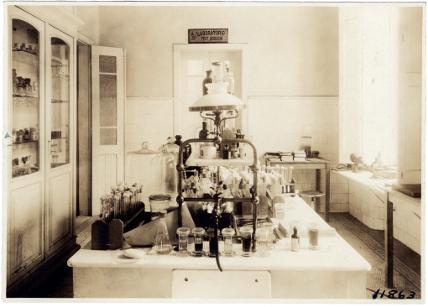
Yellow Fever Laboratory, Oswaldo Cruz Institute, Bahia.