Magdalena Grüner, University of Southern California Society of Fellows in the Humanities, "On Watery Ground: Picturing Seeing in the Dark."
Historians of science have recently begun to examine role of the oceans themselves in human activity, not just as a pathway between places that matter, but as a place with a history of its own, with which humans have always interacted. In turning their gaze to the other two thirds of the earth's surface, scholars thus acknowledge the oceans as a changeable and changing place, affecting and affected by human activities. This "oceanic turn" is playing out in the humanities broadly, as scholars in many disciplines explore the role of the oceans in human endeavors including labor, culture, politics, industry, law, or literature. Spanning many different periods and regions around the world, this group will examine broad conceptions of oceans across history.
Upcoming Meetings
Tuesday, November 17, 2026, 2:00 - 3:30 pm EST
Tuesday, December 15, 2026, 2:00 - 3:30 pm EST
Morgan Hardy, University of Tennessee, paper title TBA
Tuesday, January 19, 2027, 2:00 - 3:30 pm EST
Ada Ferraresi, DEEPMED project at University of Sevilla, dissertation chapter title TBA
Tuesday, February 16, 2027, 2:00 - 3:30 pm EST
TBA
Tuesday, March 16, 2027, 2:00 - 3:30 pm EDT
TBA
Tuesday, April 20, 2027, 2:00 - 3:30 pm EDT
TBA
Tuesday, May 18, 2027, 2:00 - 3:30 pm EDT
TBA
Tuesday, June 15, 2027, 2:00 - 3:30 pm EDT
TBA
Past Meetings
-
Pedro Afonso Cristovão dos Santos, Universidade Federal da Integração Latino-Americana, "The Sargasso Sea and the 'Discovery' of the Americas: 19th Century Transnational Debates on Nautical History and Historical Geography"
-
Ali Glassie, Northeastern University, Syllabus Assessment Workshop: "Ocean Literacies"
-
Oceans HSTM Book Club: The Sequel!
Alison Glassie (Northeastern University) will lead us in a discussion of Ned Beauman's novel Venomous Lumpsucker.
The book should be available at all the usual places, and probably at your local public library.
-
We will gather informally to hear about all of our research, plans, and summer travels. Please join us!
-
Penelope K. Hardy, University of Wisconsin-La Crosse, "Science from the Quarterdeck: Naval-Scientific Networks and the 1870s Challenger Expedition"
-
Seth Stein LeJacq, Hunter College, The City University of New York, "Hidden Crimes: Sexual Violence and Historical Memory of Britain’s Navy in the Age of Sail"
-
Daniella McCahey (Texas Tech University) and Sam Robinson (University of York), "Research and Development in the Dependencies of the Falkland
Islands’: The Discovery Committee and the Early Politics of the Discovery Investigations"
-
Aijie Shi, University of Wisconsin-Madison, “The Life History of Laminaria japonica in the Northwest Pacific”
-
Aaron Van Neste, Oberlin College, "The Rise and Fall of the South African Pilchard and Anchovy Fisheries (1950-1980)"
-
Karen Pinto, University of Colorado-Boulder, “All the World’s an Island: A Taussigian Reading of Ancient, Medieval, and Early Modern Maps with an Islamicate Twist”
-
Our December meeting is cancelled. See you in January!
-
Sonya Schoenberger, Stanford University, "Enclosing the Sea: Marine Resource Sovereignty and the Rise of 'Large Ocean States' in the Postwar Pacific"
-
Scott Erich, Washington College, "The Subterranean Sea"
-
Kamil Ahsan, Yale University, "The Reef in the Oilfield: Petroleum Geology, and Oil Fetishism in Post-War British Honduras (1950-1990)"
-
Oceans Book Club! We're reading Ray Nayler's The Mountain in the Sea (2022).
Grab the book, give it a read, and join us for a discussion led by Alison Glassie (Northeastern University).
-
Publishing Roundtable!
Meet journal editors from Mainsheet, Coastal Studies & Society, The Northern Mariner, and Animal History and ask them anything about submitting your article
-
Samantha Muka, Stevens Institute of Technology, "Extending the Petroleumscape: Building the Liberty Ship Reefs in Texas Coastal Waters"
-
Antony Adler, Carleton College, "Afterlives of Interspecies Collisions: Giant Squid and Knowledge of the Sea"
-
Zi Yun Huang, University of Chicago, Dissertation Prospectus for "A History of Plankton Science from Protoplasm to Petroleum"
-
Derek Nelson, Skagit Valley College, "An Atlantic Framework for the History of Marine Borers ”
-
David McCaskey, University of California, Riverside, "Net Losses: The Failures and Successes of Trawling in French Indochina"
-
Katharine Anderson, York University, "The Artificial Perspective: William Beebe, the Modern Observer and Oceanic Natural History”
-
DEEPMED Project, "Visualizing the 3D Mediterranean (and beyond?): A Work in Progress Session"
-
Anna Guasco, Oregon State University, "'Could do better to stick to his fish’: Knowledge, Power, and Authority in Gray Whale Science.”
-
Max Chervin Bridge, Brown University, "Hearing Sperm Whales"
-
Lynn Nyhart, University of Wisconsin-Madison, "Popular Evolution Meets the Ottoman Empire: Situating Ernst Haeckel's Arabian Corals (1875)."
-
Alison Glassie, Northeastern University, "Olokun's Aquarium"
-
Oceans Digital Humanities Round Table
Join us as a panel of historians shares their expertise, experiences, and insights in Digital Humanities.
Sean Fraga, USC Dornsife
Jonathan Galka, Harvard University
Anke Finger, University of Connecticut
Christine Peffer, H-Net Humanities and Social Sciences Online
-
Pamela Overmann, head curator for the Naval Art Collection, United States Navy History and Heritage Command
-
Jonathan Galka, Harvard University, "Mineral Dreams: Manganese Nodules & Anticolonial Worldmaking at Sea."
-
Alessandra Passariello, Naples Zoological Station, "The Bay of Porto Paone: The First “Tiny Underwater Nature Reserve” in the Gulf of Naples (1960-1966)"
-
Elexis Trinity Williams, Cornell University, "Seeing with Sound: Acoustic Epistemologies at Sea"
-
Kimia Shahi, University of Southern California, "Charting Coastlines and Visualizing Slavery: Visibility and the Limits of Cartography in the Coast Survey’s Maps"
-
Anne Ricculli, Morris Museum, "Coral Fisheries, Neglected: Peter Lund Simmonds and the Economics of Depth-Dependent Research, 1860s-1870s"
-
**NOTE SPECIAL DATE AND TIME**
We're partnering with the International Commission of the History of Oceanography to host a fun and informal reading group of portions of Jamie Jones's new book, Rendered Obsolete: Energy Culture and the Afterlife of US Whaling, with the intention of bringing together scholars of ocean history across Asia and beyond (thus the special time slot!) This meeting is concerned with thinking about how intersections between energy and environmental history at sea are understood and explored in Asian oceanic contexts, but it is also about introducing ourselves to one another and making connections across shared interests among those working in and on the Asian region. Readings from the book's introduction and first chapter will be posted in advance of the meeting.
-
Nancy Ko, Columbia University, "Absorbent Empire: An Ecological History of Sephardic Memory in the Global Dodecanese"
-
Natalia Gándara Chacana, Pontificia Universidad Católica de Valparaiso, Chile, "Below the waves: the construction of knowledge about the depths of the Southeastern Pacific during the Age of Revolutions"
-
Robert Batchelor, Georgia Southern University, “Reframing Borderwaters: Marshall Island Stick Charts as Infrastructures”
-
Helen Rozwadowski, University of Connecticut, "Sounding Ocean Maps for Early Modern Understanding of the Volumetric Ocean"
.
NOTE re: downloads: Turn on comments in the PowerPoint PDF to match the figures with the text.)
-
Jennifer Hubbard, Toronto Metropolitan University, "Colonizing the Oceans: Fisheries Scientists as Agents of Empire in the Pacific"
-
Ellen Arnold, University of Stavanger, "Dangerous Waters"
-
Dominik Hünniger, Universität Hamburg, “Unnamed marine animals” – knowledge formation on oceanic microfauna, ca. 1750-1850"
-
Victoria McAlister, Towson University
“The Herring Speaks: Exploitation of Marine Resources in Medieval and Early Modern Ireland.”
-
Kunyan Zheng, Trinity College Dublin, "Health from Nature: Medical Knowledge of Marine Fish Fish in England, c. 1540-1700"
-
Lino Camprubí, Universidad de Sevilla, "Jason and the Argonauts: Temporality, Usability, and Tacit Knowledge in Remote Ocean Monitoring"
-
*Note Special Time*
Samantha Muka, Stevens Institute of Technology, " 'A New York Institution': The impact of the New York Aquarium on the development of American biology, 1898-1967"
-
Urna Mukherjee, Johns Hopkins University, "Malabar Teak" and "Bengal-made Canvass": Indigenous Expertise in Eighteenth Century Shipbuilding in British Colonial Bombay and Calcutta
-
Jack Bouchard, Rutgers University, New Brunswick.
Two chapters from his manuscript Terra Nova: Work, Water and Food in an Early Atlantic World
-
"Oceans in the Archives"
Join us as a panel of archivists introduce us their collections on ocean history, finding aids and funding for researchers.
Featuring:
Laura Kissel, Polar Curator (Byrd Polar and Climate Research Center Archival Program, The Ohio State University)
Daniel Lewis, Dibner Senior Curator History of Science & Technology (The Huntington Library, Art Museum & Botanical Gardens)
Josh Levy, Historian of Science and Technology (Manuscript Divison, Library of Congress)
-
"Oceans in Museums"
Join us as a panel of museum professionals share their favorite objects and collections, discuss the challenges of curating ocean exhibits, and share resources for researchers.
Featuring:
Dr. Erika Jones, curator of navigation and oceanography, (UK) National Maritime Museum
Dr. Katrin Kleemann, postdoctoral researcher, Deutsches Schifffahrts Museum
Dr. Kevin Sheehan, collections manager, Maritime Museum of San Diego
-
"Teaching Ocean History"
Join us as a panel of historians discuss their experiences teaching the history of oceans to students in various academic contexts. We will also precirculate their syllabi for discussion.
Helen Rozwadowski (University of Connecticut, Avery Point)
Samantha Muka (Stevens Institute of Technology)
Jonathan Galka (Harvard University)
Jack Bouchard (Rutgers University)
-
Jakobina K. Arch, Whitman College, "Mitigating Risk: Cultural and Economic Adaptations to Oceanic Dangers in Tokugawa Japan."
-
Katherine Sinclair, Rutgers University, " 'A Magnificent Natural Zoo': Domesticating the French Kerguelen Islands."
-
Alison Glassie, Mahindra Humanities Center, Harvard University, "Ninety Perfect Sealskins: Toni Morrison’s Counter-history of Sealing."
-
Beatriz Martínez-Rius, Sorbonne Université, "International science, salt domes, and oil: deep-sea drilling in the Mediterranean."
-
Magdalena Grüner, Universität Hamburg, "Else Bostelmann’s Abyssal Visions and the Ocean-Surreal"
-
Emily Hutcheson, University of Wisconsin-Madison, "Seeing Ecologies of the Deep and Shallow Seas: Local Labor and Knowledge in the Malay Archipelago, 1899-1900"
-
Judy Johns Schloegel, Independent Scholar, "Instituting Biology in the Great Lakes: Scientific Survey Work and Inland Seas Maritime Culture, 1893-1903."
-
Penelope K. Hardy, University of Wisconsin-La Crosse, seeks your input on her new project: a four-volume edited primary source collection tentatively titled Knowing the Oceans, 1790-1914: A Global Documentary History.
-
Ann Elias, University of Sydney, chapters 2, 4 and 6 from her book Coral Empire: Underwater Oceans, Colonial Tropics, Visual Modernity (Duke University Press, 2019)
*NOTE SPECIAL TIME*
-
Presenting at a conference this summer? Attended a really good panel? Come tell us about it! We'll meet in July for a meet-and-greet and conference round-up. Bring your conference reports, publication announcements, and news for this informal get-together.
-
We will meet for a wrap-up/discussion of the year's meetings, asking members to identify together themes and questions that arise organically from the papers we've discussed so far. We'll also start planning for the fall; if you have ideas, requests, or questions about presenting a paper to the working group, bring them!
-
Jennifer Hubbard, Ryerson University, "Rescuing the World: The Food and Agriculture Organization and the Quest for Efficient Scientific Administration in World Fisheries"
-
Katharina Steiner, University of Wisconsin-Madison, "Changing Audiences, Changing Meanings: Haeckel’s Copepods and Biology’s Popular Culture"
-
Samm Newton, University of Wisconsin-Madison, "Pteropods Realized: From Bio-indication to Bio-inspiration"
-
Larrie Ferreiro, George Mason University, "The Technology of Armed Oceangoing Ships and the Rise of Overseas Empires"
-
Emily Hutcheson, University of Wisconsin-Madison, "'So-called' coral reefs: The Global Circulation of Algological Knowledge through Imperial and Scientific Networks 1896-1930" (from her dissertation in progress)
-
Tamara Fernando, University of Cambridge, "Seeing like the Sea: a Multi-Species History of Labour, Capital and Science Underwater at the Pearl Fishery of Ceylon 1800-1925"
-
Will Scates-Frances, Australian National University, "Captain Vanderford's Rule" (from his dissertation "Faces of Nature: The Race Thinking of Charles Pickering on the United States South Seas Exploring Expedition 1838-1842")
-
Sean Fraga, University of Southern California, "Settler Steamboats: Mobility, Settler Colonialism, and Steam Power in the Terraqueous Pacific Northwest, 1846–1872"
-
Vaughn Scribner, Central Arkansas University, selections from his new book Merpeople: A Human History (Reaktion Books, 2020)
-
Christine Keiner, Rochester Institute of Technology, selections from her new book Deep Cut: Science, Power, and the Unbuilt Interoceanic Canal (University of Georgia Press, 2020).
-
Samantha Muka, Stevens Institute of Technology, "Taking Hobbyists Seriously: Reef tank hobbyists and the scientific value of serious leisure"
Group Conveners

Max Bridge
I am a postdoctoral fellow at Harvard University's Mahindra Humanities Center. Recently graduating from Brown University, my dissertation project - "Oceanic Listening: Sound, Cetaceans, and the History of Sensory Environments" - placed sound at the center of human-cetacean history and placed sensory experience at the center of how past environments have been known by human and nonhuman subjects. My work traces how sound shaped human, whale, and dolphin relationships across histories of whaling, science, aesthetics, and popular culture over the past 200 years. My next project will reconstruct the environmental history of disability activism in the 20th-century United States.

Penelope Hardy
Penelope K. Hardy is a historian of science, technology, and medicine and an associate professor at the University of Wisconsin-La Crosse. She studies the historical intersection of technology and the ocean sciences. Her current book project examines a series of nineteenth- and twentieth-century ocean-going research vessels and the cultures and practices surrounding their use. She is a vice president of the International Commission of the History of Oceanography, is vice president for research and publications of H-Net, and helped to found H-Oceans.
Daniella McCahey
Daniella McCahey is an Assistant Professor at Texas Tech University, where she primarily teaches on British history and the history of science. She studies the relationship between science and the environment in Polar and ocean regions. She is the co-author of Antarctica: A History in 100 Objects (Bloomsbury 2022) and the co-editor of Antarctic Materialities (Berghahn 2026).
326 Members
You must be a member to view resources. Login or create an account
Image
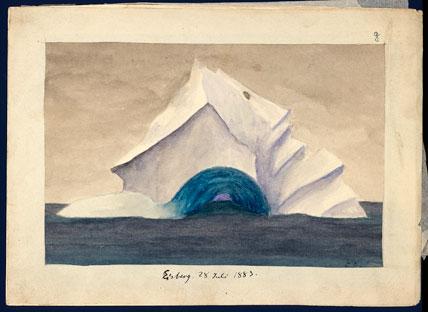
Iceberg from arctic expedition of Franz Boas, July 28, 1883.