COALITION BUILDING
In conversation with Dana Simmons (UC Riverside) and Nayanika Ghosh (Duke).
This group provides a unique forum for historians of science to discuss the challenges and responsibilities of being a historian of science in the world today. It provides a safe, structured, and tolerant environment for members to talk about the history of academic freedom in relation to current attacks on STEM and Higher Education. A primary purpose of the group is to develop skills and capacity for protecting that freedom in a historically informed and self-reflexive way. Our goal is to produce a documentary record of the field as it is under pressure and evolving in front of our eyes. We hope that this orientation will coordinate action in the present and will also create a resource that future historians can meaningfully engage.
COALITION BUILDING
In conversation with Dana Simmons (UC Riverside) and Nayanika Ghosh (Duke).
TEACHING
In conversation with Fritz Davis (Purdue) and Stephen Weldon (Oklahoma).
INTERNATIONAL PERSPECTIVES ON ACADEMIC FREEDOM
TBA
HISTORICAL PRECEDENTS
TBA
STS & POLITICS OF EXPERTISE
ENGAGING PUBLICS
TBA
TBA
ARCHIVING
In conversation with Laura Stark (Vanderbilt), Adrianna Link (APS), and Peter Sachs Collopy (Caltech).
Recommended resources to review for this meeting include:
-The Vernacular Archive of Normal Volunteers: https://hollisarchives.lib.harvard.edu/catalog/med00524
-The Dictionary of Archives Terminology (participants are encouraged to start by looking up the word "archive" itself!): https://dictionary.archivists.org/entry/archives.html
-Richard Shryock's "The Viewpoint of an Historian and a Manuscript Librarian," attached below.
At this first gathering, we plan on discussing the larger goals of the group, the tentative schedule of working group topics for the year, and take some initial steps on our archiving project. In anticipation of all of this, we wrote up a short “prompt” for you to think with. Attached!

Alexandra Hui is currently a visiting researcher on as a Safe Place for Science Fellow at the University of Toulouse. From 2008-2026 she taught history of science and German history at Mississippi State University. From 2019-2024, she co-edited the History of Science Society publications, including the journal Isis. Her scholarly articles, anthology chapters, and monograph, The Psychophysical Ear: Musical Experiments, Experimental Sounds, 1840-1910 (MIT Press, 2012), explore the relationship between science, sound, and music. She has also co-edited Testing Hearing: the Making of Modern Aurality (OUP, 2020) and the 2013 Osiris volume on music, sound, and the laboratory. Hui has received support from the National Science Foundation, the Fulbright Foundation, and the Alexander von Humboldt Foundation. In November of 2026, MIT Press will publish her co-edited (with Emily Pawley) A Historian’s Handbook for Saving the World: Responding to the Global Climate Emergency, a series of essays, interviews, and resources to inspire and equip humanists to intervene in global climate change. Hui has just completed her second scholarly monograph, Surround Sounds: The Science of Background Music, on the co-development of new forms of listening and background music technology in twentieth-century America. She currently working how field scientists, ranging from ornithologists to hunters to foresters to wetlands managers, listen to the environment and the way in which this listening contributes to the formation of what Hui terms "imagined ecologies."

Judy Kaplan is a cultural and intellectual historian of the human sciences with a focus on nineteenth- and twentieth-century linguistic research. She has published widely on subjects from orientalism to sound studies and is currently working on a project that unravels histories of research on language universals. She was a NSF Fellow in Residence at the Consortium for History of Science, Technology and Medicine and is currently a Public Historian at the Science History Institute in Philadelphia, PA.

Claire Conklin Sabel is a historian of early modern earth sciences, extractive industries, and empire, with expertise in Dutch and British empires in Southeast Asia. Her research explores how knowledge about the earth and environment were shaped by the growth of European imperialism and overseas trade in the Indian Ocean. She received her PhD in History of Science from the University of Pennsylvania in 2024 and is currently a postdoctoral researcher on the ERC project SCARCE, and is affiliated with the Key Research Area in History of Science. This project aims to produce a critical history of natural resource management, focusing on Central Europe in a global perspective.
She is currently working on her first book in progress, Rare Earth: Gemstones, Geohistory, and Commercial Geography c. 1600-1750, and is developing a second project on gendered expertise in early modern mining, “Expanded Horizons: Women and the Making of Natural Resources in the Early Modern World.
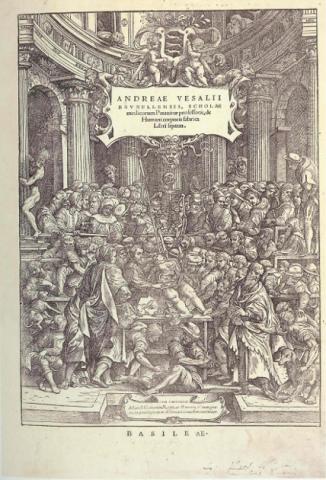
Andreae Vesalii Bruxellensis, scholae medicorum Patauinae professoris, De humani corporis fabrica libri septem. Basileae: Ex officina Joannis Oporini, anno salutis reparatae MDXLIII. [1543].
© 2026 Consortium for History of Science, Technology and Medicine | Copyright Infringement