Alina Bykova, Stanford University,
"Svalbard is a state of mind: heroism, science and the international Arctic (1920-1939)"
The earth’s frozen regions feature in diverse ways throughout the history of modern science. As destinations for scientific expeditions, sites for the establishment of observatories and testing grounds, contact zones for western scientific and indigenous knowledge traditions, and as repositories of water supplies or climate data, these environments have been—and continue to be—sites of significant scientific interest and activity. Increasing concern over rising global temperatures has only helped to stimulate this interest and activity.
This working group offers a forum for scholars across the humanities and social sciences working on the history of science in (and on) frozen environments. Alongside high-altitude and high-latitude regions of the earth, it also includes the study of frozen materials such as snow, ice, and permafrost, as well as the role these materials play in wider earth systems. Sessions are designed to support new projects and publications exploring these histories. Participants will have the chance to give and receive feedback on their work, meet collaboration partners, discuss outreach opportunities, and generally help raise the profile of this diverse and pressing area of historical research.
Alina Bykova, Stanford University,
"Svalbard is a state of mind: heroism, science and the international Arctic (1920-1939)"
Cristián Simonetti, Pontificia Universidad Católica de Chile, paper title TBA
TBA
TBA
TBA
TBA
Pierre Salvadori, Université Lyon 3
"Polar Knowledge as Situated Concerns, late 16th-early 17th centuries"
Thomas Simpson, University of Warwick
"Knowing Earth through ice: frozen matter and planetary sciences before ESS"

I am an environmental and science historian working on the history of the Earth Sciences in Central Asia and the Caucasus. I have previously published on the history of Soviet climate science and I'm currently working on a book project on the environmental history of glaciers in Central Asia for the 19th and 20th centuries.

Daniella McCahey is an Assistant Professor at Texas Tech University, where she primarily teaches on British history and the history of science. She studies the relationship between science and the environment in Polar and ocean regions. She is the co-author of Antarctica: A History in 100 Objects (Bloomsbury 2022) and the co-editor of Antarctic Materialities (Berghahn 2026).

Floris Winckel is a Postdoc at the Niels Bohr Archive and University of Copenhagen, where he examines the institutionalization of snow and ice science in the twentieth century. He completed his doctorate at the Ludwig Maximilian University in Munich, writing about the long-term history of snowflake science. As a historian of science he is chiefly interested in histories of the earth and environmental sciences. He is also broadly interested in the way these histories relate to contemporary debates about climate science and geoengineering.
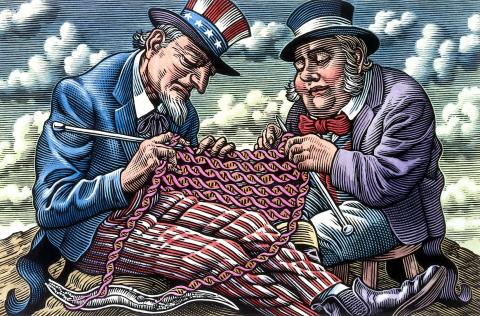
Anglo-American research on the human genome, represented by Uncle Sam and John Bull knitting DNA. Scraperboard drawing by Bill Sanderson, 1990.
© 2026 Consortium for History of Science, Technology and Medicine | Copyright Infringement