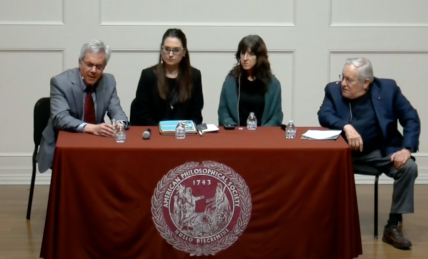
William Krause is a Ph.D. Candidate in the Department of History at Vanderbilt University and a 2024-2025 Consortium Research Fellow.
My project is a conceptual history of the idea of genius in modern American life. How, I ask, did the seemingly elite, esoteric concept of individual genius achieve a prominent place in American public discourse over the twentieth century? The project focuses on how the concept of genius transformed – and was transformed by – key American institutions, including the public school, the university, the high-technology laboratory, the industrial factory, and the home throughout the twentieth century. As a 2024-2025 Consortium Fellow, I visited three archives that contained foundational material for my dissertation: the Rockefeller Archive Center, the Newberry Library, and the Rare Books and Manuscript Library at Columbia University. Each archive had material that allowed me to track the flow and import of genius in the twentieth century, with papers of significant figures, institutions, and movements that helped shape the idea since roughly the First World War.
First, I investigated Franklin and Penelope Rosemont Collection of IWW Publications and Ephemera at the Newberry Library in Chicago. The Industrial Workers of the World (IWW or Wobblies) was a radical labor union that formed in the early twentieth century. In their colorful magazine publications, propaganda, and leaflets, the Wobblies deployed the concept of genius with surprising frequency and force. Whether exalting the “genius of labor,” the role of labor in major technological inventions, or attacking the “genius” of high-profile inventors like Henry Ford, the Wobblies fastened the concept of genius to international labor, revealing the concept’s relevance to American political culture. If academic writing underscored the eminence and creative contribution of individual geniuses, the Wobblies’ interpretation of genius highlighted the contribution of labor to historical and technological progress. In addition to collections related to the IWW, I also used the John L. Monroe Collection of Exposition Postcards and the Claire Lieber Crews Century of Progress Notebook – both of which allowed me to juxtapose the Wobbly propaganda with more mainstream portrayals of industrial genius during the interwar years.
Further, as a Consortium Fellow, I visited Columbia University’s Rare Book and Manuscript Library. There, I investigated the archival collections of Robert K. Merton, an American sociologist who wrote on science and invention during the Cold War years. Merton, like many other interpreters of scientific labor during the late-1950s and early-1960s, tried to explain the existence of scientific and inventive genius within the context of the institutions, communities, and networks that enabled its expression. By juxtaposing individual genius and the sociological dimensions of science, Merton sought to demystify the concept for readers. At the RBML at Columbia, I also investigated Carnegie Corporation of New York Records. In the middle of the twentieth century, the Carnegie Corporation of New York funded grants related to creativity research and gifted and talented programs, both influencing how Americans conceived of genius.
Finally, I visited the Rockefeller Archive Center, where I examined the papers of Warren Weaver. Weaver was an American mathematician who played a key role in developing the Salk Institute for Biological Studies. Founded in 1960 by virologist Jonas Salk, the Salk Institute aimed to identify brilliant scientists and equip them with resources that would allow them to participate in the life sciences revolution. The Salk Institute shaped popular sensibilities about science by fostering public and humanistic writings about science, including figures such as novelist Michael Crichton, philosopher Jacob Bronowski, and anthropologist Edgar Morin. Many public-facing works by Salk Institute visitors, and Salk himself, underscored the role of individual genius in the progress of science and history – at the expense of networks, hidden labor, institutions, and other more nuanced ways of understanding science. In addition to the Warren Weaver papers, I also investigated the F. Champion Ward Professional Papers and the Francis X. Sutton Papers. Sutton and Ward both worked at the Ford Foundation and helped establish the MacArthur Foundation Fellowship during the 1980s. The MacArthur Foundation, like the Salk Institute, had a strong influence on public sensibilities about individual genius. This research supplemented research I had already done at UC: San Diego, the University of Chicago, and the American Philosophical Society.
The Research Fellowship at the Consortium for History of Science, Technology and Medicine benefitted my project by not only by enabling me to conduct necessary research but also by connecting me with a network of interdisciplinary scholars committed to understanding the past and present of science, technology, and medicine. In addition to the monthly meetings – where I had the opportunity to learn about the cutting-edge research conducted by other Consortium fellows – I also enjoyed the Consortium working groups. The virtual community of scholars related to the Consortium incubated the development of my own work, helping me sharpen my research, writing, and thinking.
I am enormously grateful for support from the Consortium, which deepened and expanded my project on the popular intellectual history of genius. The Consortium Fellowship was the ideal fellowship for my dissertation year because it gave me access to a diverse network of member institutions, allowing me to grasp the contrasting modes of understanding genius that textured U.S. political discourse. I am thrilled to be part of the Consortium and look forward to future participation with this vibrant and rich intellectual community.