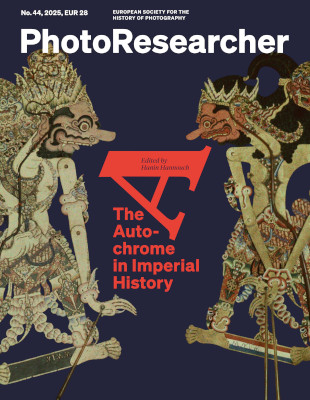
“The Autochrome in Imperial History” / Edited by: Dr. Hanin Hannouch
PhotoResearcher No. 44, 2025 / Orders (physical journal or Pdf) to be sent to: office@eshph.org
- Editorial, by Hanin Hannouch**
- Housing Privileges: Tassilo Adam’s Autochromes of the Bosscha Estate in Java, by Hanin Hannouch**
- Autochromes for Empire: J. C. Warburg at the 1908 Franco-British Exhibition, by Janine Freeston**
- Extracting the View: Fred Payne Clatworthy’s Autochromes of the American West, by Rachel Lee Hutcheson*
- The Autochrome in Iceland: Colour Photography on the Far Periphery of Europe, by Inga Lára Baldvinsdóttir
- The Reception of the Autochrome in the Russian Empire around 1900, by Nadezhda Stanulevich*
- Between Center and Periphery: Autochrome Photography Through the History of Present-Day Slovakia, by Kitti Baráthová, Katarína Beňová & Janka Blaško Križanová
- Pepper’s Ghost. A Living Autochrome, by Bronwyn Lace* & Anna Seiderer*
**: Co-Convener of the Working Group “Color Photography in the 19th Century and Early 20th Century: Sciences, Technologies, Empires”
*: Speaker and Member of the Working Group “Color Photography in the 19th Century and Early 20th Century: Sciences, Technologies, Empires”
The Autochrome in Imperial History: Color Photography’s Global Entanglements
This issue of PhotoResearcher centers the role of the Lumière brothers’ Autochrome in global colonial and political contexts. The impetus behind creating “The Autochrome in Imperial History” is the Tassilo Adam Collection, housed at Weltmuseum Wien in Vienna. Adam, a plantation manager and photographer in the Dutch East Indies, gifted the photography collection, including his Autochromes, to the Weltmuseum Wien in 1940. A handful of these Autochromes depict the lavish estate of Karl Bosscha in Java, Indonesia. Their representation marks a shift in the conventional colonial gaze, turning inwards, by meticulously showcasing the European settler’s domestic sphere.
Over the years, several authors came to the attention of the editor thanks to the online working group on color photography around 1900, co-convened with Janine Freeston at the Consortium. Together, we formed an extensive network of scholars, curators, and artists keen on critically approaching color photography. This network regularly met and exchanged viewpoints and still does so until today through and thanks to the Consortium who has continuously supported this niche research topic.
This volume distinguishes itself from prior scholarship on the Autochrome by prioritizing the medium’s political deployment over poetic or aesthetic interpretations. The global perspectives presented through various case studies span cases across Iceland, Great Britain, the Russian Empire, colonial Indonesia, the United States of America, the French Empire and the Austro-Hungarian Empire. They demonstrate the Autochrome’s function as an instrument of imperial modernity, facilitating both the creation and dissemination of colonial viewpoints and the documentation of the empire’s aftermath.