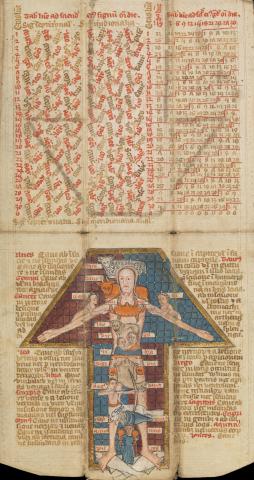
Columbia University has added several notable collections, covering broad topics including earth, computer and physical sciences, as well as institutional and philanthropic records.
School of Mines memoirs and theses, 1873-1930
Starting in 1864, students at the School of Mines were expected to visit mining and metallurgical establishments during the summer vacation. On their return to campus, they were required to hand in a journal of their travels and a "memoir" (i.e., and official report) on an assigned subject. This collection contains the volumes with the School of Mines memoirs and theses mostly from the 1870s to the 1910s.
Frank Da Cruz papers, 1889-2011, Bulk 1947-2011
Frank Da Cruz (CC 1970) served as a member of the Columbia University Information Technology (CUIT) department, including Director, Communications Software Development. At Columbia, he helped create Kermit, a file transfer/management protocol, first used in 1981. This collection consists of Da Cruz's personal papers related to the 1968 Columbia student uprising, and his writings and research materials relating to the history of computing at Columbia and Wallace Eckert, a Columbia professor of astronomy and IBM pioneer.
The glass plates of astronomical photography by Lewis Morris Rutherfurd have been digitized, ingested into the Digital Library Collections, and linked to the finding aid.
Wallace S. Broecker papers, 1953-2019
Wallace ("Wally") Smith Broecker (1931-2019) was an American geologist and geochemist, best known for developing the idea of the Great Ocean Conveyor Belt and popularizing the term "global warming." He was the Newberry Professor of Geology in the Department of Earth and Environmental Sciences at Columbia University and a scientist at Columbia's Lamont-Doherty Earth Observatory. Beginning in 1953, he spent over 60 years at Columbia, publishing over 500 journal articles and 17 books. The papers consist of journal articles, data, scientific reports, manuscripts, correspondence, awards, tributes, photographs, videocassettes, lecture slides, and an exhaustive collection of his published articles and books.
Center for the Study of Global Habitability records, 1983-1993
The Center focused on global changes resulting from the interventions of people on the environment. The Center led a University Seminar, whose objective was to define, discuss and illuminate the scientific and social issues relating to the environment of the planet and the human impact on it. The collection consists of the Center for the Study of Global Habitability administrative files, including grant information and event coordination. It also contains records of the related University Seminar, both the agendas, minutes, and transcripts as well as some audio cassette recordings.
D. G. Aubrey collection on the Caspian Sea and Mobile Bay, 1955-1992
D. G. Aubrey is a coastal oceanographer who conducted foundational research on the Caspian Sea's coastal dynamics, sea-level fluctuations, and environmental conservation. His 1994 proposal to the Global Environment Facility (GEF) remains a cornerstone for understanding the basin's ecological management. The collection contains transparencies and slides used for presentations and lectures.
Dale Library on Weights and Measures, bulk 1415-1929
This library consists of books and pamphlets tracing the development of standard measures in all countries and over all periods. This finding aid is the culmination of a large project to catalog the Dale materials. Nearly 700 books and other printed items are cataloged in the Columbia Libraries Online Catalog, while the remaining nearly 2,000 pamphlets are listed in this finding aid.
Carnegie Secretary Records, 1911-2018
The Carnegie Secretary records consist of the minutes of the Board of Trustees and the Executive Committee. For certain minutes, this series also includes supporting materials such as agendas, resolutions, correspondence, draft minutes, and other related archival material. Minutes from 1911-2008 are available. Agendas are available for 1926-1997. Materials are openly available, and are full-text searchable at https://dlc.library.columbia.edu/carnegie.
In addition to illuminating the Carnegie Corporation's philanthropy, these records serve as an entryway into the individual grant records in series III. Past researchers would often have to first consult these minutes to find relevant grant records, and then request those records as well. This set of digitized and openly available materials will allow researchers to do this work remotely, and use their reading room time to consult grant files.