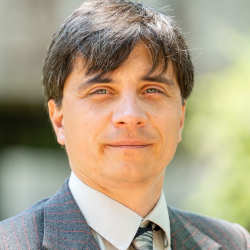
Alexey Golubev is an Associate Professor in the Department of History at the University of Houston, and a 2024-2025 Consortium Research Fellow.
To this day, our understanding of how knowledge circulated in the Cold War Soviet Union is influenced by the tropes of institutionalized ignorance and state-mandated obfuscation. Dating back to the early twentieth-century anti-Bolshevik propaganda, but perhaps even more so to the post-WWII anti-Communism, and encapsulated in the Orwellian slogan “Ignorance is Strength” (Nineteen Eighty-Four), these tropes suggest a regime that maintained power by keeping its citizenry in the dark. However, the historical record tells a radically different story. Starting in 1947, the same year George Orwell started work on his famous novel, and throughout the entire Cold War period from late Stalinism to Mikhail Gorbachev’s perestroika, Soviet authorities and intellectuals conducted one of the most massive state-sponsored campaigns for public communication of science in history.
My monograph, tentatively titled Knowledge Propaganda: Cold War Socialism as an Epistemic Project, seeks to document this campaign and its profound impact on Soviet modernity. At its heart was the Society Znanie (Knowledge), a voluntary learned society that, over the course of post- WWII decades, mobilized millions of experts to disseminate scientific, medical, and political knowledge through an expansive network of lectures, museums, and print media. Far from a policy of ignorance, the Soviet state treated the public communication of knowledge as a central instrument of state-building, aiming to produce epistemic sovereignty by shaping what citizens knew and how they knew it. This campaign developed in a landscape of persistent secrecy, and there was an obvious element of ideological indoctrination and social engineering to it, yet at the same time the desire to create scientific citizenship was equally at its core.
During my tenure as a Research Fellow at the Consortium for History of Science, Technology and Medicine, I focused on documenting the transnational dimensions of this project. While the Soviet effort was often framed in terms of advancement of socialism (vis-à-vis capitalist societies) and national interest, the archival materials at member institutions reveal a complex landscape of global networks, academic exchanges, and ideological competition that influenced how both East and West understood the relationship between science and the public.
Why the CHSTM member archives?
The necessity of visiting the Consortium’s member archives arose from a significant geopolitical shift that disrupted my original research plans. While my project relies on a foundation of primary sources gathered during visits to Moscow and Petrozavodsk in 2018 and 2021, the outbreak of the Russian-Ukrainian war in February 2022 rendered Russian archives inaccessible. This left me with some lacunae in my source base, particularly regarding the international outreach and transnational implications of the Soviet scientific literacy campaign. To complete the manuscript, I pivoted my research to North American collections that could offer a different perspective on Soviet epistemic governance and scientific citizenship.
The collections of the Consortium member institutions, indeed, provided valuable materials that helped me address some of my gaps. Columbia University’s Rare Book and Manuscript Library proved to be a treasure chest for documenting the conceptual parallels between Soviet and American efforts. The David A. Hamburg Papers provided information on the initiatives spearheaded by the American Association for the Advancement of Science (AAAS) during Hamburg’s tenure as an AAAS Board of Directors member and later its chairman and as President of the Carnegie Corporation of New York. These records illustrated that a similar “deficit model” of scientific literacy drove dissemination campaigns on both sides of the Iron Curtain. Hamburg’s papers, which include materials on American studies of Soviet science and Soviet-American academic exchanges, also provided evidence for how scientific knowledge and pedagogical strategies circulated across the Iron Curtain despite the ideological divide. Equally useful were the Boris Rabbot Papers and Mark Popovsky Papers. In my manuscript’s fifth chapter, I engage in an extensive discussion of a 1950 popular science book by Aleksandr Popovskii, the father of Mark Popovsky. Examining the son’s papers allowed me to better understand the political pressures and the specific professional habitus of the Soviet popularizer community in which his father operated. The Boris Rabbot Papers offered significant evidence of the “technocratic turn” during the Cold War that I discuss in my Chapter 5. Rabbot’s records as a sociologist help illustrate how the Soviet leadership increasingly turned to specialized knowledge as a primary tool for governance and social engineering.
The American Philosophical Society Library in Philadelphia provided a glimpse into the institutional and intellectual foundations of the history of Soviet science as a discipline – one that my book manuscript is in a dialogue with. The Loren Graham Papers are a monumental collection that future generations of historians will undoubtedly find essential for examining the origins of Soviet science studies in the West. For my project, these papers were particularly valuable in tracing how the study of science (including its communication to the public) was gradually integrated into the broader field of Slavic studies during the détente and Second Cold War. I also consulted the Conway Zirkle Papers, which offered a different kind of insight. While Zirkle published most of his research on Soviet biology and Lysenkoism, his intellectual workshop (unpublished notes and drafts) revealed how he consistently measured Soviet scientific output according to its perceived distance from Western norms. This finding provided me with additional evidence for my discussion of epistemic arbitrage in Chapter 1, where I analyze how both Soviet and Western actors leveraged the perceived gaps between their respective knowledge systems for political and professional gain.
At Princeton University Library, my research focused on two distinct collections that illustrate the diverse ways scientific and political knowledge were mediated in the West that were relevant to my book manuscript. The Council on Foreign Relations records provided a fascinating point of comparison for my Chapter 6 that discusses what in the USSR was called the “propaganda of political knowledge.” In the Soviet context, this was the domain of the lektorskii aktiv (lecturer corps) of the Communist Party Central Committee. Knowledge articulated by them then trickled down to Soviet regions via the vertically organized infrastructure of political propaganda. The CFR records demonstrate that a structurally different yet ideologically similar effort was instrumental to keeping the American public informed through invited lectures and expert briefings. While the forms of engagement varied, the underlying objective of maintaining an informed citizenry through elite-led dissemination was remarkably similar across both superpowers. The Immanuel Velikovsky Papers offered a different but equally interesting perspective, demonstrating how the blurring of boundaries between the “ivory tower” of science and the broader public was a transnational phenomenon, providing a necessary Western parallel to the Soviet case that I discuss in Chapter 4. It was very illuminating to find a letter from Velikovsky to Iosif Shklovskii, one of the most prominent science popularizers in the USSR.
My visit to the Rockefeller Archive Center was productive in terms of relevant primary sources, but also in unanticipated ways – it served as an inspiration for me to expand my section on “The Materiality on Knowing” (Chapter 3) which discusses the historical relationship between knowledge and power. The inspiration came from the very materiality of the archive, housed in the former Hillcrest residence on the Rockefeller family estate. Working in the reading room of an institution that transitioned from a private center of global wealth to a repository for the history of science policy and social engineering, with its core collections of philanthropic foundations and non-governmental policy organizations reflecting a technocratic approach to social engineering and science policy, I found striking parallels to the ethos of the Soviet knowledge dissemination campaign that was at its core a social engineering project of the same magnitude. As for specific collections, the Ford Foundation archives, specifically the records of the Social Science Research Council’s Joint Committee on Soviet Studies, were indispensable. Much like the Loren Graham Papers at the APS, these records reveal the institutional foundations of Soviet studies in the West and document the specific mechanisms of epistemic arbitrage across the Iron Curtain. Documents related to academic exchanges and the organization of graduate training in the US were particularly interesting.
Fellowship Outcomes
The fellowship supported by the Consortium served as the final catalyst for the completion of my book project. In addition to the discovery of specific documents, it helped me understand the broader intellectual and epistemic landscape of the Cold War within which this project developed. This included a clearer understanding of why the Soviet enlightenment effort was often recognized in the West primarily as propaganda. My research suggests that this was simultaneously a proper recognition – identifying a social engineering effort intended to change attitudes toward knowledge – and a misrecognition of intent, as these efforts were often dismissed as mere indoctrination rather than recognized as a complex project of scientific citizenship.
This “meta-level” of analysis, as well as individual archival finds – such as the Zirkle Papers at the APS, the Immanuel Velikovsky Papers at Princeton, and the Mark Popovsky and Boris Rabbot Papers at Columbia’s RBML – were invaluable as I finalized the manuscript over the past academic year. I am pleased to announce that this fellowship was an important contribution to the completion of the project; the final revisions were profoundly informed by my time in these collections. In March 2026, I submitted the manuscript, Knowledge Propaganda: Cold War Socialism as an Epistemic Project, to Oxford University Press, where it is currently undergoing peer review.