Samantha Muka is Associate Professor in the Science and Technology Studies Program at the Stevens Institute of Technology, and a 2024-2025 Consortium NEH Fellow.
My research looks at the history of coastal engineering and waste management in the United States from 1950-2000. In the second half of the twentieth century, American coastal states found themselves in a conundrum—their economies relied heavily on the aesthetic quality and ecological health of coastal ecosystems and the ability to use marine spaces for waste disposal. Maintaining coastal spaces for tourism, fishing, and habitation was integral to the economic health of both Atlantic and Pacific states. Each year, more tourists flocked to American beaches, learned to dive and snorkel, and owned boats and beach houses. However, the ocean had also traditionally served as a dumping ground; a wasteland capable of absorbing and hiding the growing detritus of post-war industrial growth. As cities grew along the coastline, the ocean became an important sink for disposing of the waste of nation building.
One way that federal and state governments threaded the needle between coastal health, aesthetics, and waste management was to use waste in coastal engineering projects. Between 1950 and 2000, local and federal governments worked with a variety of stakeholders to use waste in projects described as protecting, enhancing, and conserving the coastline. My larger project, tentatively titled Trashing the Coast: Waste management and coastal engineering, looks at the ways that the coastline was shaped through waste engineering and management. Each chapter follows a specific type of waste, through local and state concerns about disposal into the larger academic science and engineering debates regarding its impact on marine spaces.
The forms of waste I focus on are dredge spoil, coal and industrial waste, automobiles, ships, and oil rigs. Engineers, ecologists, state and federal authorities, and local boosters worked together (and actively debated) throughout the latter half of the 20th century to dispose of these materials through the creation of coastal infrastructure. They built new islands out of dredge spoil and artificial reefs from a variety of materials for diving, angling, and surfing.
During my time at the Consortium, I concentrated on materials related to the coastal management and engineering of the New York Bight. The Bight is the name for the marine space between the tip of Long Island and the terminal end of New Jersey at Cape May. This space is used by two major states for shipping, leisure, and waste management. It has also traditionally been a heavily fished region, with artisanal and commercial boats taking striped bass, bluefish, tautog, and other fin fish, as well as scallops and other mollusks and crustaceans. Until 1999, the Long Island Sound lobster fishery was the second largest in the US; it collapsed due to climate change and catch has decreased by 90%.
To understand the nature of waste management and engineering in this space, I concentrated on three archival collections.
Bill Bradley Papers housed at the Princeton University Archives
Bill Bradley was a Democratic senator for New Jersey from 1979-1997. Each summer he walked the entirety of the Jersey Shore, and many of his initiatives, including his work on decreasing medical waste on Jersey beaches and advancing clean water initiatives in New Jersey, intersect with my project. These papers are extensive and contain letters from constituents to Bradley, including letters from the commercial fishing, dredging, and shipping groups in the New York Bight. These letters offer insight into the tangled desires of stakeholders in this area.
Both sets of correspondence, and the congressional notes on Bradley’s medical waste and clean water bills, offer insight into the management of the New York Bight and the conversations about building and maintaining the coastline during this period. Of particular interest is the bipartisan Coastal State group started by Bradley; this group of around 30 Senators became a powerful lobbying force for marine engineering. Connie Mack (R-Florida) joined Bradley in many of his coastal initiatives, showing how coastal infrastructure and waste management were a bi-partisan issue during this period.
During his tenure, Bradley worked to completely stop marine dumping (along with his fellow senator Frank Lautenberg, 1982-2001) off the coast of New Jersey. Sludge, the term for semi-solids left after the treatment of raw sewage, was dumped as close as 12 miles off the coast of the Bight. Over the course of the 1980s, the dump site was moved to 106 miles off-shore. Bradley pushed to close that dumpsite. This was in direct opposition to D. Patrick Moynihan, a Democratic senator from New York.
Daniel Patrick Moynihan Papers at the Library of Congress
This set of papers, housed at the Library of Congress, provided a fantastic perspective on the interstate politics of coastal waste management. New York and New Jersey pool funding for maintenance of the New York Bight through the Port Authority of New York and New Jersey (established 1921). The interstate politics of this come into focus when you visit the Bradley and Moynihan papers. As Bradley sought to stop the dumping of municipal waste in the Bight, Moynihan worked with the Environmental Protection Agency to develop “scientific” dumping, a way to continue to dispose of municipal waste in designated areas off the coast. These letters, and especially the involvement of the EPA, offer a vision of the relationship between government scientists, engineers, and ongoing debates about marine health.
One of the most interesting parts of the Moynihan papers details the political impact of the Army Corps of Engineers deciding that they would stop beach restoration on Long Island in the early 1980s. The Corps decided that it was too costly and ineffective to continue to maintain the Long Island shoreline and proposed stopping yearly sand movement. The Moynihan papers contain hundreds of letters from citizens decrying this plan and talking about how important their coastline was to both property values and the local economy. Eventually, the plan was scrapped, and beach maintenance continues today.
Bella Abzug Papers at Columbia University Archives
The final archives I visited were the Bella Abzug Papers at Columbia. Abzug was a Democratic representative in the House from 1971-1977. While remembered as a feminist icon, Abzug sat on several environmental committees and was dedicated to environmental conservation in both New York City and the United States. Her papers include letters from constituents regarding her work on a variety of conservation initiatives, including bills that would lead to the Marine Mammal Protection Act.
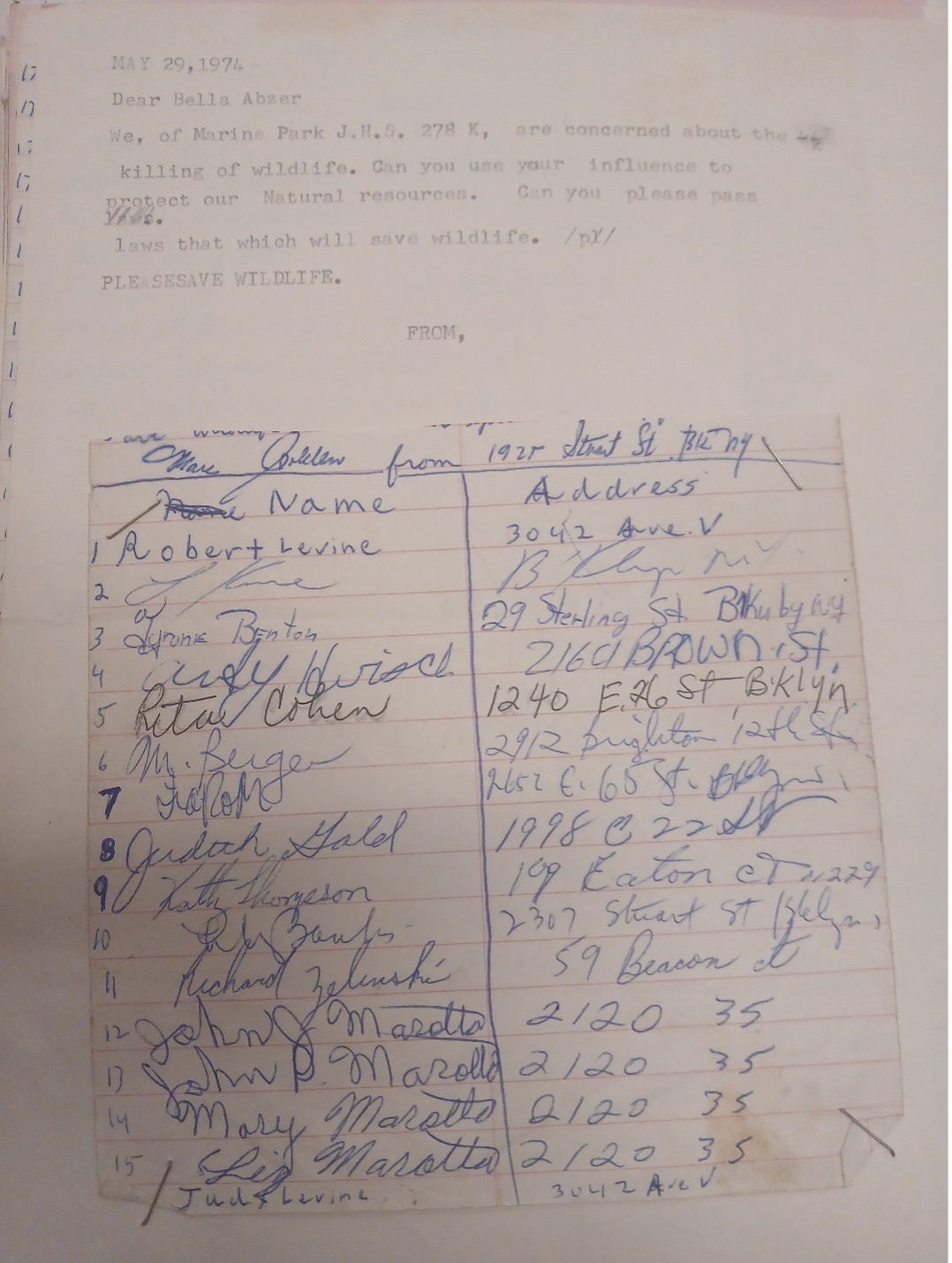
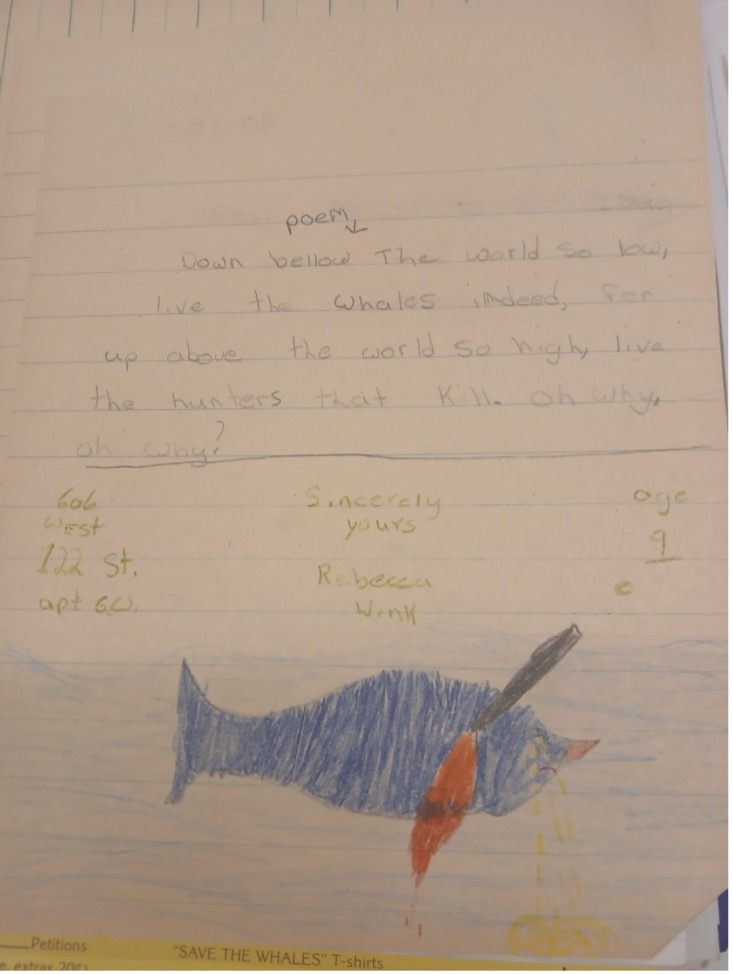
These papers reveal the impact of more local politicians on coastal politics, and it always widens our understanding of stakeholders and their attention to coastal policy decisions during this time. In a folder of correspondence titled “whales”, are letters from school children throughout New York. These letters urge Abzug to protect the ocean, to stop whaling, and to enforce an embargo on Japanese goods until they cease whaling. Similar to the constituent letters to Moynihan regarding beach building on Long Island, these letters show how broad concern about marine conservation was during this time.
These archives allowed me to see how decisions were made regarding coastal engineering and conservation between 1970 and 2000. They helped me to focus on the link between local and national politics and to better understand the rise of marine conservation concerns at this time.
Othmer Library
The other major actors are the academic and commercial scientists and engineers that produce research and provide expertise. While some scientists and engineers appear in the congressional records, it was also important for me to review the accepted literature of the day. In the Othmer Library, I was able to find a huge amount of published information with impacts on coastal engineering and conservation of the time, including literature on sludge cleaning technologies and techniques, as well as EPA pamphlets and scientific reports on dioxin and other heavy metals in marine substrates. In addition, the library has a variety of sources on the development of rubber tires and the use of these tires and automobiles as artificial reefs.
Together, these sources show how important waste management was both to U.S. coastal environments and American’s attitudes toward those environments. My work contributes to discussions in marine environmental history, envirotech, and discard studies. My research at the Consortium resulted in preparation of an article on the development of American marine conservation as well as a book proposal.