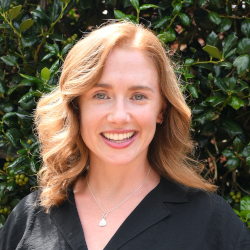
Clare Byers is a 2025-2026 Consortium Research Fellow.
Humans are only beginning to contend with the physical reality of “the cloud” and artificial intelligences. Today, massive, windowless data centers filled with servers and wires for data storage and processing dot across the world, affecting the lives, physical space, and the water security of the people living in their vicinity. These sites for the recording, storage, transmission, and replication of information echo the management of earlier information booms; those printed and written on paper in the eighteenth century dotted their way across European global empires. This latest wave of information change, the digital age, brings to the fore questions about information behaviors. Why do people retain and store information that no longer has credibility? How do people persist in using outdated information? How does the information change in the hands of its users? Whose lives or legacies are affected by these new, reproductive uses of information?
Rooted in information science, questions about information making and taking bring circulation of knowledge to center stage. Information behavior theory allows scholars to delve into not only how information is gathered, made, and produced, but also the reproductive cycles of print present in information taking. Information taking includes behaviors ranging from obtaining and retaining physical forms of information to reproducing information through extraction, abstraction, derivation, study, collation, and organization. Information making ties clearly to environmental history in its productive capacity. But what about information taking? My research looks directly at reader behaviors as a form of information taking and the reproductive actions that fuel the multiplicity of information that began during the eighteenth century but continues today.
My project, tentatively titled Forgotten Journeys: The French Bestsellers that Shaped American Exploration, centers on a series of six case studies about originally French popular books about travels in North America, and the natural history and geography of the regions visited. It is both an environmental and intellectual history of North America. It tracks the long process of knowledge circulation from local and indigenous actors living in the expansive territory of French Canada and Louisiana through the publication of information by French travelers to the presence of information in dictionaries of commerce and on mineralogical maps. Publication becomes a material manifestation of information behavior, a bridge between nature and human understanding. Consider this process in general terms.
From a view of Niagara Falls and the long, sometimes treacherous journey down the Mississippi River, to a Mandan myth about a large body of salt water and the manitou (the life force of all beings among Algonquian-speaking peoples of North America) in beavers or muskrats, nature shaped the information transmitted. First, a local or indigenous person shared a story, recorded their own experiences or testimony, or a traveler asked a question, or witnessed a phenomenon or interaction. The traveler recorded his eyewitness experience on paper or sometimes birchbark.
Later, he took his gathered notes and information to Europe and penned a narrative account of his experiences Sometimes, publishers and patrons helped print these accounts as books that gained popularity. The books were reproduced in new editions, translations, and formats. From there, the information diffused into articles in scientific journals, magazines, and newspapers, printed sermons, divisive political pamphlets, and even novels. The information changed as it moved. Reshaped to fit the needs of its latest user, the information was abridged, extracted, rearranged, and joined with other information, opinion, or testimony from other travelers and European scholars. Meanwhile, other information, particularly about indigenous and local information sources became obscured or lost in the process as new users took what they deemed useful and left aside the remainder.
When I began this year as a Consortium fellow, my research tracked the diffusion of information in each of my case studies into the various print productions and reproductions manifested throughout the eighteenth century. What was not clear, however, was the physical movement and specific information-taking behavior involved in the information circulation process. How and why did people continue to use outdated information from these printed books long after they had proven to be false narratives? When, why, and how did knowledge about North America return to North America in printed form? I set out to understand how, when, and why physical forms of information made their way throughout empires, returning much closer to their place of origin. After all, why would a person collect and read a book about a place when he or she could so easily travel there? With these questions in mind and with the support of the Consortium, I visited the collections of the American Philosophical Society (APS), the Newberry Library and the Huntington Library.
At the APS, I consulted each copy held in their collection of the books from each of my case studies. What quickly became apparent was that members used the books not only for information-taking, but also for knowledge-making, as they inscribed their thoughts, observations, corrections, and cross-reference information directly into the margins of the copies. For example, in the six-volume duodecimo edition of Jesuit missionary Pierre François-Xavier de Charlevoix’s Histoire et Description Generale de la Nouvelle France (1744), a reader made note in Charlevoix’s index of North American plants of the Linnaean nomenclature where Charlevoix had used his own Cartesian naming system in the printed text. The reader also offered observations of physical size and color not directly apparent from the engravings. For example, on the engraving of the groundnut (apios Americana), the reader noted “root as big as an egg in some rich moist land; in general, only as [big as] a hazelnut.”
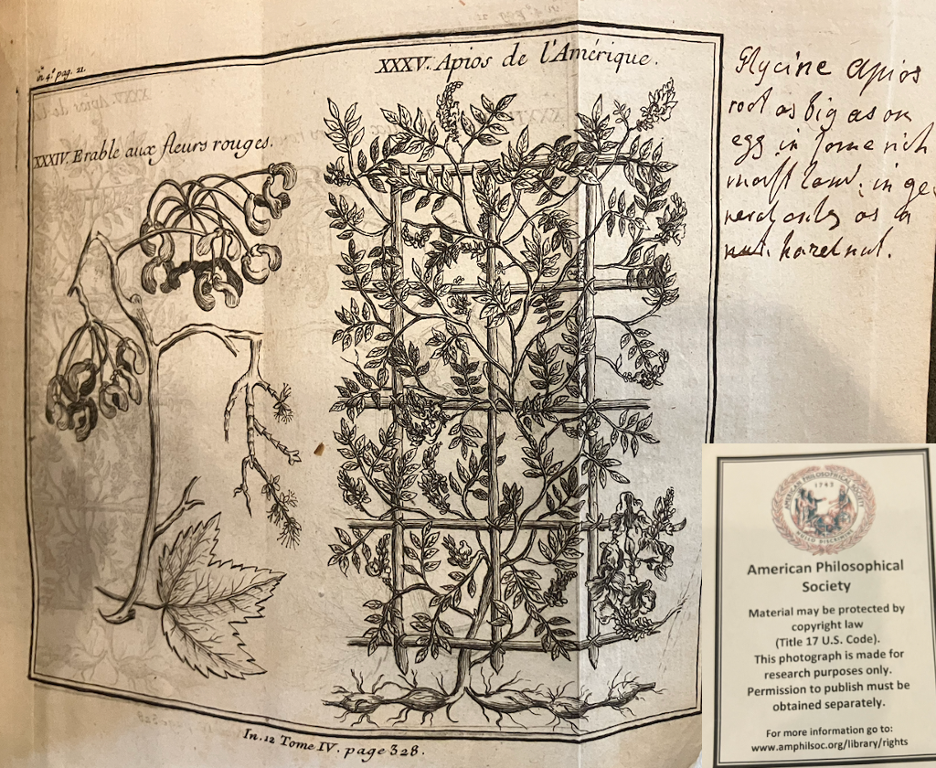
Figure 1. Manuscript notes on a plate in the APS’s copy of Pierre François-Xavier de Charlevoix, Histoire et Description de la Nouvelle France IV (Paris, 1744), plate XXXV Apios de l'Amerique. Courtesy of American Philosophical Society.
Similarly, in the APS’s second English edition of Louis Hennepin’s A New Discovery of a Vast Country in America, a reader made notes in the margin throughout the journal entries recounting the journey down the Mississippi River calculating the distances Hennepin traveled and the time each leg of the journey took. Paired with the manuscript account sent in 1803 by Charles François Adrien le Paulmier (France's general consul to Virginia and Maryland) detailing the waterways of Louisiana, as well as George Hunter’s letters to the APS recounting William Dunbar’s journey to the Louisiana territory in 1804 following the Louisiana Purchase, the notes in the Hennepin edition make sense. From their location in Louisiana, members could use older accounts to help plan and track future journeys, to check different accounts against one another, and to aggregate information to inform decision making.
At the Newberry, I encountered similar marginal manuscript notations in copies that were later collected from eighteenth-century owners and readers of the books. One eighteenth-century reader of the Baron de Lahontan’s New Voyages to North America (1703), noted in the margin where Lahontan lists the locations, languages, and names of different indigenous peoples he encountered, the English term “Iroquois or Five Nations” in place of the individual names Lahontan had noted. In fact, this was not the first time I encountered this intervention in the text. In a copy held by the Redwood Library in Newport, Rhode Island (one of the earliest subscription libraries in North America), one of the collection’s original volumes is the 1703 English edition of Lahontan’s New Voyages, where Lahontan notes the “Tsonontouans, Goyogouans, Onnotagues, Onnoyoutes, and Agnies,” a reader added the English names in a list: “Senecas, Cayougas, Onondagas, Broyders, Magnas.” These are not the names these peoples ascribe to themselves, the five members of the Haudenosaunee Confederacy: the Kanien’kehá:ka (Mohawk), Oneniote’á:ka (Oneida), Ononta’kehá:ka (Onondaga), Kahoniokwenhá:ka (Cayuga), Tsonontowane’á:ka (Seneca). In an act of information-taking, a reader has used ink on the page to establish new sovereignty over the information, in this case, from French to English. And such interventions in the text that may, on the surface, read as corrections or clarifications, can be understood in the imperial context as acts of establishing power, dominance, and control over territory at a distance.
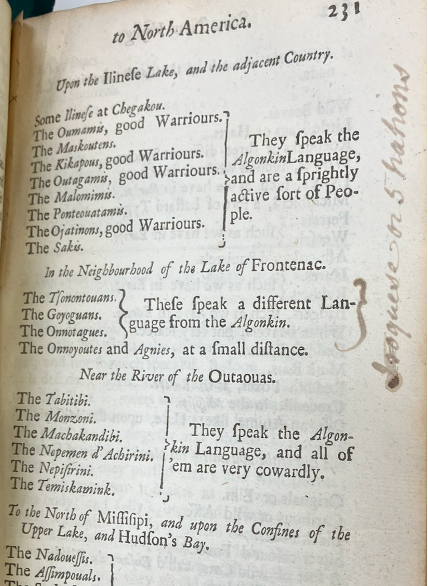
Figure 2. Manuscript notes from a former owner of Lahontan’s New Voyages to North America (London, 1703), Newberry Library, Chicago (Vault Ayer 123 .L16n 1703). Courtesy of Newberry Library.
At the Newberry, I also began investigating why these older books continued to circulate after newer information had become available and been published. In consultation with Suzanne Karr Schmidt, curator of rare books and manuscripts, I became acquainted with Jacob Christian Schäffer’s Doctors der Gottesgelehrsamkeit und Weltweisheit, a fascinating volume published in 1765 documenting potential solutions to a perceived crisis in rag supply for papermaking. He was not the only person to investigate other potential materials for paper. In 1761, Joseph de Lalande presented Art de Faire Le Papier to the Paris Académie des sciences to investigate the origins of and potential alternatives to contemporary papermaking practices. With a perceived shortage of the raw natural materials (typically linen and cotton rags) for papermaking and amid the ongoing seemingly limitless need for paper, revisiting the production processes for alternative solutions seemed necessary. In this context, the second-hand market for older books was ripe. Older books could be sold cheaply by lot and readily shipped to quickly grow new collections in North America where printing was scarcer and more expensive, and papermaking was just beginning.
With the remaining question of why a person might collect and read a book about a place when he or she could so easily travel there, I visited the Huntington to investigate manuscript collections of various individuals. I encountered the correspondence of brothers James and William Mercer. James, a British officer, led troops at Oswego during the Seven Years’ War. James wrote of the atlas of American territory he sent to his brother so that his nieces could see on the map where their uncle was fighting. He wrote also of his eagerness to move north, not only to see action against French troops, but also for the opportunity to see the famous Niagara Falls, which he may have read about in the work of Louis Hennepin. Before he could make the journey, James Mercer was killed by French cannon fire when allied French and indigenous troops took the Fort.
As I read, I wondered what books James had brought with him to North America. The remaining correspondence paints a picture of William as a bereaved brother who spent the remainder of his life trying unsuccessfully to recover the chest containing his brother’s papers and books. Apparently, when the French took the fort at Oswego, they thought the officer’s personal collection and writing might prove militarily useful, so it was taken north to Canada, where eventually it became lost and was never recovered even after peace treaties were signed and Britain took control of Canada. In considering this episode as an information making and taking interaction, it becomes apparent that value lay in possibility for usefulness and power. Eighteenth century paper was the medium for most circulation of information throughout global empires. Individuals took control through possession, and they established their own sovereignty and power through ink. However, loss was also part of the process. Paper is ephemeral, whether bound into books, sent as letters, or even used as waste for cartridge making during military engagements.
Thanks to Consortium support, I found evidence that readers’ engagement with books is one measure of a book’s relevance and value. The results bring into focus how and why the books remained useful to readers sometimes one hundred years later. Printed cheaply in many copies and editions, these books remained in circulation. When paper was scarce, information was still readily available via a vibrant secondhand market. Once in possession of a book, readers take control of information. They extend their personal imprint on books in ink by making notes, sometimes directly on the book itself, correcting the information, posing questions, making calculations as they imagine the thought process of the author, consider physical changes of the environment, treating the texts as an historical record, and correct information that has changed over time. Readers use paper and ink to transmit their new perspectives of the printed books, considering new scientific discovery, changing territorial dominion, and continued interests in the possibilities of natural resources.