Richard Barney is a 2025-2026 Consortium Research Fellow.
Under the general rubric of “the afterlife of alchemy,” I have conducted research from February to August 2026 at four archival libraries with a Consortium fellowship. As a literary scholar, my object has been to study the history of modern chemistry, a relatively unfamiliar topic both for myself and eighteenth-century British literary and cultural studies, with two targets: first, completing the historical picture related to aesthetics during the period for a book titled The Sublime’s Crucible: Eighteenth-Century British Aesthetics in a Biopolitical Era, while compiling additional material for a projected second book whose working title is “The Afterlife of Alchemy.” For both aims, my goal has been to examine the revaluation and ultimate revitalization of alchemical ideas during Britain’s so-called long eighteenth century (ca. 1660-1830), the period typically characterized as the era when prescientific perspectives gave way to those of modern science. In conventional accounts of this transition, alchemy’s inherent mysticism was ultimately set aside in favor of creditable methods of experimentation and empirically verifiable proofs.
One figure who in the past exemplified the shift to scientific thinking, however, Isaac Newton, has more recently been shown to have experimented with alchemical methods until the end of his life in 1727. His masterful Principia Mathematica, in other words, first published in 1687, by no means produced Newton’s complete break from earlier kinds of knowledge. Drawing on that example, as well as recent work by scholars including William Newman, Helen Thompson, and Rajani Sudan suggesting that we revaluate alchemy’s history, I have set myself the task of exploring the strange double life of alchemy over the course of the Enlightenment: on the one hand, its being ridiculed or satirized as an outmoded, even superstitious, system of knowledge, while, on the other, particular aspects of alchemy, including the principles of sublimation and distillation, found new life in the work of various writers. My research intervenes in previous discussions of alchemy’s historical arc in two ways: first, it resists the tendency, even in recent accounts, to treat alchemy’s persistence well into the Enlightenment as a kind of intellectual hangover or a recalcitrant sociocultural inclination that refused the improvements of modernity. Second, it extends and complicates the revisionist scholarly descriptions by Thompson and others by investigating the specific ways that refashioned alchemical thinking informed both British aesthetics and sociopolitical thought during the long eighteenth century.
With the support of the Consortium, I spent several intense weeks at the Thomas Fisher Rare Books Library at the University of Toronto, the Newberry Library in Chicago, the Library of Congress, and the Dibner Library of the History of Science and Technology at the Smithsonian. (An additional grant from UCLA also enabled me to spend a month researching at the William Andrews Clark Memorial Library, which is part of the Center for 17th- and 18th-Century Studies. All these institutions have my wholehearted thanks for their support and resources.) The results have been substantial and gratifying. First, my research enabled me to finish the manuscript for The Sublime’s Crucible, which explores the relation between the history of medicine and the way that authors ranging from Anne Finch to Joseph Addison to Edmund Burke described how witnesses confront the experience of the sublime. These authors agreed that the sublime had a powerful, even traumatic, impact as a grand or terrifying phenomenon, whether in the form of a cataclysmic natural event—such as an earthquake, erupting volcano, or devastating storm—or as a work of art representing such an event in painting, poetry, or music. They differed, however, in the ways they described the human body’s role in shaping that experience, and how they imagined in turn its ability to influence an individual’s sociopolitical perceptions or commitments. While studying the importance of eighteenth-century physiology’s account of the eye, the spleen, or the nerves for these writers, moreover, I also discovered that Addison drew on seventeenth-century descriptions of the body as a subliming machine, one that converted the raw material of food into increasingly refined substances that ran the gamut from promoting digestion (via “chyle”) to supporting the operations of the brain (by way of the “animal spirits”). For Addison, in other words, the body operated on the model of sublimation: the process of superheating a solid so intensely that it leaps past the liquid state and converts immediately into gas. That was my first clue that the Enlightenment’s aesthetic of the sublime was linked not only to notions of human physiology but also to the adaptation of alchemical experimentation—one of whose primary techniques was sublimation—to thinking along the lines of modern chemistry.
By the point of winter 2026, I had already established a general sense of how the modern adaptation of alchemical ideas influenced Britain’s popular, nonscientific discourse, but I had very little knowledge of the original al/chemical texts on which that transition had been based. I had realized, for instance, that as a reflection of Enlightenment authors’ knowledge of chemical ideas, the verb forms of the word sublime—including sublimes and sublimed—were just as predominant during the eighteenth century as the noun versions. In addition, the notion of subliming made the transition to a number of metaphorical purposes, such as for John Andrews, who in 1783 remarked that by keeping an open mind, “human nature is sublimed, as metals through fire are disencumbered of their dross, and attain their highest degree of purity.” This kind of terminology thus found its way into numerous sermons, poetry, novels, and philosophical treatises. But it was my research for the first eight months of 2026 that revealed the complete picture of how eighteenth-century chemists refurbished alchemical terms and concepts as the backdrop for aesthetic thinking during the eighteenth century. The overarching thesis of The Sublime’s Crucible had been that a generalized notion of subliming had enabled writers like Addison, Finch, Burke, and Mary Wollstonecraft to explain the ways that primary physiological reflexes could be translated into the benefits of sublime experience that such authors always claimed for it—an inspired sense of self-enlargement, moral insight, and even spiritual edification. But I was able to make that notion all the more concrete and persuasive when my recent research established the historical co-emergence of modern chemistry’s retooling of alchemical premises and the equally significant emergence of thinking about the sublime, one of the most popular topics for discussion and debate for authors ranging from Burke to Immanuel Kant to Jean-Jacques Rousseau and Wollstonecraft. Hence The Sublime’s Crucible will be the first book in literary and philosophical studies to establish the underlying medical and chemical premises for thinking about aesthetics during the British Enlightenment.
The next phase of my research related to the Consortium fellowship will explore further the implications of sublimation as a popular eighteenth-century trope, while extending the analysis to other al/chemical techniques including distillation and fermentation, both which also found their way into the texts of nonscientific writers. The most recent months of work in the archives have been crucially informative for learning how these three technologies were treated by alchemical practitioners such as Paracelsus, for instance, as key for his progressive “Ladder” of chemical processes, just as they also became standard operations adopted by eighteenth-century empirical chemists including Peter Shaw, Johan Wiegleb, Joseph Priestley, and Antoine Lavoisier. While historians of science such as Lawrence Principe and William Newman have claimed that the transition from alchemy to modern chemistry should be thought of an overdetermined historical sequence, one with overlaps between the two fields producing a long durée of change rather than an abrupt paradigmatic break, my research has been able to provide new details of that state of affairs, especially in Britain, where despite the insistence of authors such as Shaw and others, the techniques of sublimation and distillation were both empirically renovated while retaining a significant association with alchemy’s previous aura of radical transformation, even quasi-miraculous transmutation. That bivalent representation of chemical processes persisted well into the late eighteenth century, such as in the case of Wollstonecraft, who drew on sublimation in order to invoke a scientific authority for her description of the creative imagination, while also acknowledging at times that her enthusiasm for its powers could be just as blinkered as that of disparaged alchemical practitioners.
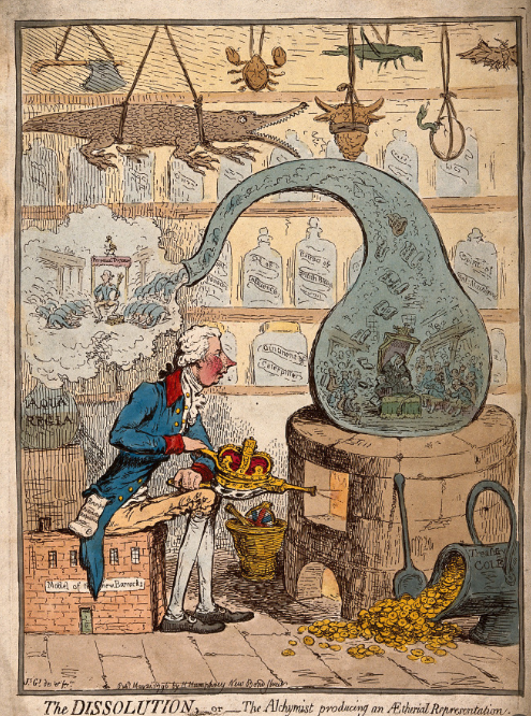
The complex emergence of modern chemistry in Enlightenment Britain ultimately sponsored what Matthew Daniel Eddy and Ursula Klein have called a “culture” of chemical ideas, included the increasing number of books on the topic, the rapid translations of recent texts from the Continent, the Royal Society’s meetings and publication of findings in the Transactions, the creation of new university professorships related to chemistry, and the lectures open both to researchers and interested amateurs. While continuing to document the terms of scientific debate during the period, my next steps will be to investigate the ways by which that “culture” found its way into the popular nonscientific texts by authors and artists of all kinds. I have several leads on that historical process that I will be pursuing with an eye, ultimately, for a book-length study. As a case in point, distillation formed a contested site for debates about morality and politics. As one example, James Gillray’s political cartoon, titled “The Dissolution, or the Alchymist Producing an Aetherial Representation” (1796), portrayed Prime Minister William Pitt as a scheming alchemist applying heat to the House of Commons, contained inside a vessel for distillation (or sublimation) called an alembic, with the aim of bolstering his own overweening ambitions in ways that verged on magical self-transformation into a royal figure--one seated on a throne to boot (see the image below).
Against that backdrop, my research will continue to track the era’s alchemical reconfigurations by focusing on sublimation, distillation, and fermentation as candidates for separate chapters. There is, for instance, the burgeoning vocabulary of “distilling” from 1710 to 1730 as a way of characterizing the national endeavor to produce social virtues such as industriousness (in the commentary by Addison, Matthias Earbery, and others) and the political merits of sovereign largess (in Daniel Defoe’s analysis of Queen Anne’s and George I’s reigns). As a counterpoint to such chemical optimism, there is Jonathan Swift’s Tale of the Tub (1704) and Gulliver’s Travels (1726), which by contrast deflate the trope of distillation by portraying it as a modern syndrome of self-aggrandizing psychology and deluded assertions of authorial genius during a period that witnessed an exponential explosion of popular print media. Later in the century, Edmund Burke’s attack on the French Revolution serves to link distillation and sublimation in a combined political lens: the French uprising had produced, Burke claimed, an “alembick of hell . . . now so furiously boiling” that it fostered the worst kind of human destructiveness. England’s Bloodless Revolution of 1688, by contrast, offered for Burke a counter example that in effect transformed small, practical reforms into a sublime national success story. Finally, there is Mary Wollstonecraft’s progressive political project in texts such as Vindication of the Rights of Woman (1792) and Letters Written in Sweden, Norway, and Denmark (1796). In the first case, she denounces women’s conventional attitudes toward romantic relationships as a kind of “philosopher’s stone,” and therefore condemns them as being as ephemeral as the legendary alchemical material supposedly able to transmogrify any substance into gold. In the second book, Wollstonecraft’s disillusionment with the political debacle of the initially inspiring French Revolution becomes encapsulated in her characterizing the chaos of The Terror as an “unnatural fermentation”—in this case, coming close to Burke’s conservative assessment of the Revolution at its very beginning. This last trope needs the most investigation as I explore what at this point seems to be an entirely negative valence for fermentation’s status as sociopolitical metaphor during what historians have frequently called the “Chemical Revolution” in eighteenth-century Britain.