
Hafeeza Anchrum is a Registered Nurse, a Postdoctoral Fellow in the Penn Program on Race, Science & Society, Center for Africana Studies, University of Pennsylvania and the 2025-2026 Consortium Albert M. Greenfield Research Fellow.
My book project, A New Era in the Fight for Racial Equality in Nursing, examines the largely uncharted history of nursing’s role in the medical civil rights movement, defined as the struggle from 1950 to 1970 to integrate hospitals, nursing and medical schools, and professional associations. The mid-twentieth century marked a pivotal turning point in power relations between White and Black nurses. The political strategies of self-reliance and institutional building employed by Black nurses and their communities for Black health improvement at the turn of the twentieth century gave way to a demand for the end of segregated healthcare in favor of the full desegregation of the nation’s healthcare system.
Between 1890 and 1950, Black resistance to medical apartheid and racial inequality took many forms, including the development of hospital-controlled nursing schools and professional organizations. The aim was to cultivate a professional class of Black nurses to serve the health needs of Black communities while providing respectable and higher-paying work for Black women. As social historians have documented, Black life in early 20th century America was characterized by high rates of illness and death, which were attributed to wide-spread poverty, inadequate living conditions, lack of healthcare access, and a scarcity of Black healthcare providers.1 Recognizing this crisis, contemporary sources emphasized the crucial role of the educated Black nurse in bridging the gap between healthcare provision and health needs. Every sector of the Black community, from wealthier elites to poor citizens, contributed to the establishment and sustainment of nursing schools to train and develop Black nurses, and in return, the Black nurse labored on the behalf of her community. This endeavor institutionalized the principles of self-help, racial uplift, and economic independence espoused by contemporary race leaders as essential mechanisms for racial advancement. By the mid-1920s, the movement had resulted in approximately 40 nursing schools and 200 hospitals serving Black Americans, including those sponsored by White philanthropists. Alongside these educational endeavors, Black nurses organized the National Association of Colored Graduate Nurses (NACGN) to advocate for their professional interests in the face of racial exclusion. They framed their struggle against racism in nursing as functioning on two mutually reinforcing fronts: improving the status of Black women in nursing and addressing the health needs of Black communities. Through organization, Black women created a powerful instrument to combat systemic racial discrimination within nursing.2 This parallel network of hospitals, nursing schools, and professional associations, sustained by communal investments of labor and resources, formed a vital institutional infrastructure that enabled Black nurses to build a skilled professional class, while providing a sanctuary to cultivate political consciousness and exchange knowledge.
Despite producing approximately 5,700 Black registered nurses by the late 1930s, health activists could not overcome the debilitating effects of systemic racial oppression. The healthcare needs of 12 million Black Americans far exceeded the capacities of existing resources. Concurrent efforts by White nurses to professionalize nursing further disadvantaged Black nurses, who recognized that new laws and regulations under Jim Crow constraints imposed additional obstacles to their advance and further constrained healthcare resources for Black communities. By 1940, the number of Black nursing schools had declined by 50%, from 40 in 1925 to just 20. Facing near-total exclusion, the NACGN spent the 1940s fighting to integrate Black women into mainstream nursing. World War II provided a crucial strategic window, allowing the organization to directly challenge racial discrimination within military nursing and federally funded educational programs. Dismantling these barriers paved the way for the integration of the American Nurses Association in 1948. Three years later, the NACGN voted to disband, declaring that a separate organization for Black nurses was no longer necessary.3 Contemporary leaders hailed the dissolution as a historic milestone that marked “the end of one era in the fight for equality for all nurses and the beginning of another.”4
A New Era in the Fight for Racial Equality in Nursing examines this next phase of the struggle through the rise and fall of Philadelphia’s Mercy-Douglass Hospital School of Nursing. As one of the nation’s few Black-controlled nursing programs at mid-century, Mercy-Douglass provided Black women with pathways into professional nursing, hospital employment, and leadership amid continued systemic exclusion. Its location in the Northeast, a region at the forefront of social and healthcare change, offers a window into exploring race, nursing, and civil rights during the 1950s and 1960s. Archival sources and oral histories reveal a central paradox: as integration and professionalization advanced, Black women gained selective access to White institutions even as their broader participation was increasingly constrained. Within this shifting landscape, Mercy-Douglass nurses pursued a dual vision of racial equality: integration into the mainstream and preservation of their own institution. Drawing on their experiences, the manuscript argues that this two-fold struggle broadened the fight for racial equality beyond a nationally led campaign for mainstream inclusion to encompass grassroots struggles for authority, self-determination, and institutional preservation.5
This research makes three principal contributions. First, it challenges narratives that treat integration and professionalization as unqualified progress. Although these reforms yielded meaningful gains for Black Americans, they also produced substantial material, cultural, and sociopolitical losses and reproduced inequality in both familiar and new forms. This project contends that these uneven consequences were constituent to the postwar transformation of American nursing. These findings demonstrate how ostensibly socially progressive projects can simultaneously reinforce oppressive structures. Second, the project intervenes in the scholarship by extending nurses’ involvement in the movement into the classical civil rights era and local communities. Moving beyond top-down accounts centered on elite national leaders and centralized organizations, the project adopts a grassroots perspective that recovers hospital nursing schools as important sites of civil rights contestation and ordinary nurses as leading actors. The experiences of these local actors indicate that Black nurses embraced a more expansive vision of equality than the existing record suggests.6 Third, the study informs contemporary questions of health equity, workforce development, and healthcare policy. The dismantlement of affirmative action and diversity, equity, and inclusion initiatives threatens gains that nurse activists secured for the health and economic well-being of marginalized communities. Such retrenchment disproportionately affects Black Americans, who continue to confront the legacies of segregated healthcare, while also exacerbating workforce shortages and limiting culturally responsive care.7 By elucidating which strategies for structural change succeeded, which failed, and why, this project provides historically grounded insights for contemporary research, policy, and practice.
With the funding support of the Consortium for History of Science, Technology and Medicine, I expanded the evidentiary and interpretative scope of my research project by examining the collections of organizations and institutions that influenced either the development of Mercy-Douglass Hospital or the broader process of nursing integration in Philadelphia and nationwide. At the National Library of Medicine, I consulted the records of the National League for Nursing (NLN), the National League for Nursing Accrediting Commission (NLNAC), and the Evelyn Tomes African American Nursing Video Collection. At the University of Pennsylvania, I reviewed the records of the Pennsylvania League for Nursing (PLN), the Pennsylvania Nurses’ Association District 2 (PNAD2), the Albert Einstein Medical Center School of Nursing (AEMC), and the Philadelphia General Hospital Training School for Nurses (PGH).
The NLN, NLNAC, and PLN records were important for understanding the state of nursing education at the national and state levels during the 1950s and 1960s. The collections document efforts to professionalize the field through educational reforms and regulations and to address growing nurse labor shortages. They also provide context for assessing the status of individual nursing programs within a rapidly changing educational and healthcare landscape. One particularly important report in the NLN records describes a 1950 initiative to assist nursing programs in attaining the newly established national accreditation. I found no evidence, however, that a Black nursing school was selected to participate. More broadly, the records contain remarkably little discussion of racial inequality among nursing schools. This archival silence is telling, suggesting that the potential negative effects of universal reforms on under-resourced institutions such as Mercy-Douglass were not treated as a central organizational concern. This omission is especially significant to my project because the inability to meet national accreditation requirements was a major contributing factor in the closure of Mercy-Douglass’s nursing school. The Evelyn Tomes Collection adds the perspectives of former NACGN leaders. In oral history interviews, they reflect on the organization’s 1950 dissolution and its consequences for Black nurses. Their accounts complicate interpretations of the dissolution as an uncomplicated triumph of integration, revealing disagreement within leadership, as well as concern that dissolving the organization weakened Black nurses’ collective identity and power.
The AEMC and PGH collections situate these national and state reforms within Philadelphia’s institutional context. The materials include administrative meeting minutes, legislative newsletters, recruitment literature, and insightful reports detailing advancements and challenges in local nursing. Complemented by student yearbooks documenting racial and gender dynamics, the sources provide critical data on race and recruitment across the city’s leading nursing schools. One unexpected finding suggests competition between Black women and White men for admission. This possibility requires further investigation, but it raises the question of whether some schools employed informal quotas that limited the representation of both groups. In sum, the collections reveal how nursing schools navigated national educational reforms, growing labor shortages, and integration demands amid shifting urban and socioeconomic geographies.
The PNAD2 and PLN collections extend my analysis from nursing education to the workforce. They document the efforts of Pennsylvania nurse leaders to improve working conditions and address critical labor shortages. The materials highlight initiatives for student recruitment and nurse retention, as well as advocacy for standardized employment practices, mandatory licensure and registration, better salaries and benefits, and the development of practical nursing programs.
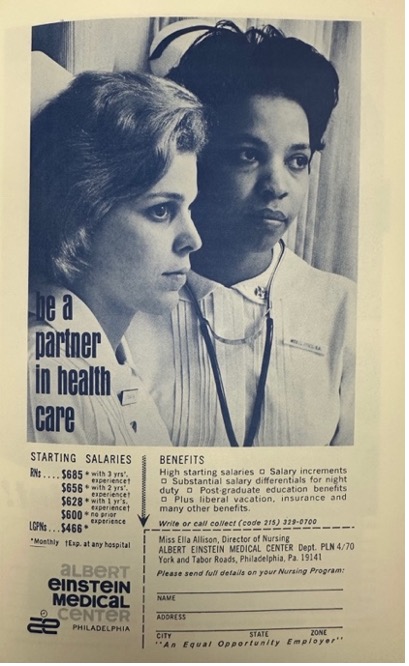
This research advances the manuscript by broadening its evidentiary and conceptual scope and sharpening its core argumentative arc. It provides new evidence about the parallel movement by nurses to dismantle structural gender inequality and occupational subordination and to establish an autonomous, self-governing profession independent of patriarchal medical dominance. When integrated with my existing research on the medical civil rights struggle, this comparative analysis demonstrates how the campaign for professionalization was, in many ways, a fight for gender equality that intersected in complex ways with the fight for racial equality. Efforts by White elites to integrate nursing, elevate its status, and secure control over its education, practice, and labor simultaneously maintained White women’s dominance and perpetuated Black women’s marginalization within the field. Synthesizing these two historical struggles reveals how nursing’s pursuit of professional legitimacy shaped both the possibilities for and the limits of Black nurses’ advancement, significantly deepening the project’s analytical impact.
Furthermore, this research drives the development of “managed inclusion” as the project’s primary theoretical framework. I conceptualize managed inclusion as a form of racial governance wherein limited opportunities for Black participation expand alongside increasingly restrictive structural conditions. The findings reveal that while professional access widened in certain respects, broad-scale reforms in nursing, such as a new national accreditation standard, placed already under-resourced Black schools at a severe disadvantage, ultimately accelerating their demise. This tension clarifies the specific vision of racial equality embraced by Mercy-Douglass nurses and why they sought integration into mainstream nursing while simultaneously fighting to preserve their own institution. It also substantiates and extends evidence elsewhere in the manuscript that the medical civil rights struggle unfolded across an ideologically divided and deeply contested political terrain. Competing visions of equality and strategies for achieving it produced distinct tensions between national and local leaders, leadership and rank-and-file nurses, nurses and physicians, and Black and White nurses.
Overall, integrating this new research deepens the project’s analysis of institutional change and power dynamics by sharpening its intersectional race and gender framework. This refined lens strengthens the central thesis and underscores the significance of the manuscript’s conclusions, demonstrating how a localized study can offer a broader critique of national healthcare policy and practice.
