
Zhongxian Xiao is a PhD Candidate in History and Sociology of Technology and Science at the Georgia Institute of Technology and a 2024-2025 Consortium Research Fellow.
Self-reliance (zili gengsheng 自力更生) was a well-established geopolitical project in twentieth-century China. In the Chinese context, it often refers to the state-led pursuit of economic autarky and political independence, emerging from China’s wartime strategies during World War II, culminating in the Cold War, and returning under Xi Jinping’s rule amid mounting geopolitical tensions. How did the idea of self-reliance persist throughout political transformations and what are its sociopolitical and ecological consequences in modern China? Focusing on the geopolitics and technopolitics of energy extraction on China’s northwestern frontier, particularly the Yumen Oilfield, my dissertation project, Extracting Self-Reliance: Petroleum and the Energy’s Making of Geopolitics in Modern China, aims to answer these questions from energy and infrastructural perspectives.
Since the 1930s, self-reliance has been closely entangled with China’s oil sector. Geological constraints and inadequate infrastructure kept domestic oil production marginal to China’s energy system and sustained its dependence on imports. As the Sino-Japanese War disrupted oil supplies from the West, the Nationalist government turned to extraction at Yumen. After 1949, this wartime pursuit of domestic energy security was recast as a broader project of socialist self-reliance. By the 1950s, socialist China sought to reinforce the energy extraction by translating the geological attributes of oil reserves into the technocratic language of central planning while aligning the diverse lives of oil workers with Maoist self-reliance. These efforts met with uneven success. From the early 1970s, China tentatively entered global markets as its oil sector gradually shifted toward international cooperation and marketization. Yet the very idea of self-reliance endured as a technopolitical project, with infrastructures and labor arrangements forged during the Maoist period continuing to shape and constrain these political reorientations in the late Cold War.
Building on the material politics and subterranean geopolitics opened by STS scholars and political geographers, my dissertation argues that self-reliance as a geopolitical notion, became durable because it was materially cemented into an extractive landscape, consisting of technical expertise, infrastructure, labor mobilization and geological conditions. Drawing on the concept of extractive landscape, my dissertation aims to excavate China’s practices of energy security beyond formal diplomacy, revealing how Cold War geopolitics and energy politics emerged not only from above, in the headquarters of governmental agencies, but also from below and underground, through the everyday life of oil towns and the hydrocarbons in the reservoir.
Bringing energy humanities and STS into dialogue with international history, my dissertation thereby calls for reading geopolitical changes against environmental and technological evidence, drawing on three layers of infrastructural archives. 1) diplomatic: records of institutions practicing energy diplomacy, from China Defense Supplies' files on wartime procurement and fuel smuggling in the 1930s–40s to the U.S. State Department's archive on technical cooperation from the 1960s through the 1980s. 2) quotidian: Yumen's municipal and oil company archives, alongside local newspapers documenting oil workers' recruitment, housing, welfare, safety, political campaigns, and technical innovation. It shows how the geopolitical agenda of self-reliance was reproduced and appropriated in the everyday life of oil extraction. 3) subterranean: technical reports of geological surveys, reserve estimates, drilling and waterflooding, and geologists’ assessments of Yumen oilfield. These sources reveal how silent, non-human actors could defy the technocratic rationale and constrain the very possibility of geopolitical and ideological change. Together, this archival approach will illuminate how the geopolitics of self-reliance, and by extension, socialism, was entangled with the technopolitics of energy extraction.
With the support of the Consortium, I was able to conduct archival research at two major research institutions, Princeton University and the Linda Hall Library, both of which hold extensive collections of published and unpublished materials illuminating the global histories of energy. In November 2025, I set out to Princeton, New Jersey, for a week of archival research. Princeton University’s Seeley G. Mudd Manuscript Library houses the Public Policy Papers, a collection that allowed me to explore substantially what I call the diplomatic layer of infrastructural archives. The Public Policy Papers document the activities of individuals and organizations that played pivotal roles in twentieth-century American foreign policy and international development. My research focused primarily on the Whiting Willauer Papers, particularly materials from the 1940s. Whiting Willauer was an American diplomat with close ties to General Claire Chennault in wartime China, serving as executive secretary of China Defense Supplies and subsequently worked with the Foreign Economic Administration. Whiting Willauer Papers therefore provide a valuable window into the logistical, technological, and diplomatic dimensions of Sino-American cooperation during and immediately after World War II.
Scholarship on energy security has largely overlooked China’s participation in global energy politics before the 1970s. Nevertheless, China was far from silent amid the shifting geopolitics of energy. The Whiting Willauer Papers offer valuable evidence of this understudied history of energy security and technological cooperation before 1949. For instance, documents titled “Southwest Transport Administration (1943–1944)” and “China Defense Supplies” that I consulted at Princeton, reveal the technical and logistical challenges confronting wartime transportation networks in China’s southwestern borderlands. Shortages of gasoline, engines, automobile parts, and maintenance equipment placed severe constraints on the movement of military supplies, prompting Chinese technocrats and American engineers to explore alternative energy sources. Among the proposed solutions, alcohol and wood gas (charcoal) emerged as potential substitutes for gasoline. Archival records document how American and Chinese engineers evaluated the feasibility and efficiency of these alternative fuels. They also reveal the active involvement of China Defense Supplies in procuring American gas-producer equipment for Chinese transportation agencies.
In fact, China’s wartime energy security was pursued not only through procurement of oil products but also through technological collaboration and the adaptation of transportation infrastructure to the local conditions of material scarcity. Beyond the wartime experimentation with the alternative fuels, the archives at Princeton Library also illuminate the continued exchange of technical expertise between China and the United States in the postwar years. Although the records are relatively scattered, documents titled the “International Supplies Corporation (China) (1948–1949)” provide some evidence of this collaboration. For instance, they show how the China Petroleum Corporation and Chinese Civil Air Transport sought assistance from American petroleum experts in evaluating domestically produced aviation gasoline. Samples of aviation fuel produced from petroleum extracted at Yumen and refined in Shanghai were sent to the California-based General Petroleum Corporation for laboratory testing and technical recommendations. Such exchanges reveal how the Nationalist government sought to develop domestic petroleum production and refining capabilities while continuing to draw upon American technical expertise. These sources also suggest that international technological cooperation extended beyond the wartime emergency into the Nationalist government’s lasting efforts during the late 1940s, to secure reliable fuel supplies in the changing geopolitical contexts.
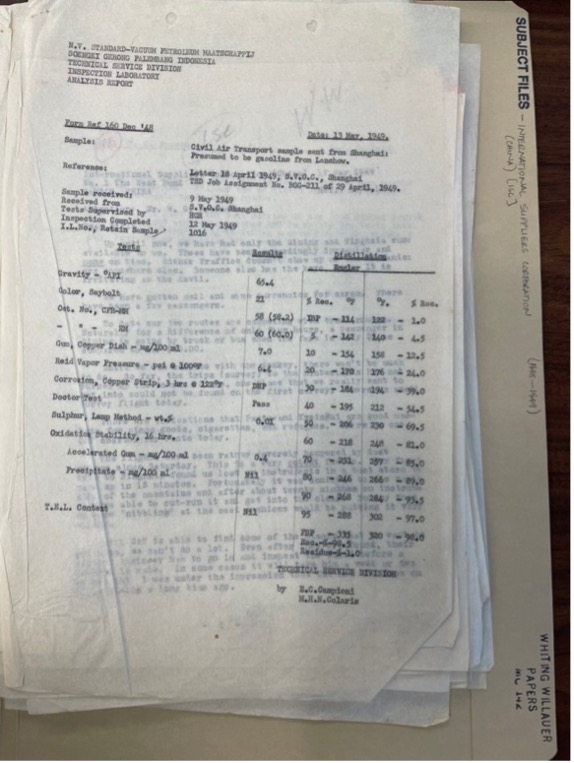
“General Petroleum Corporation 1949.5”. Whiting Willauer Papers (Princeton University Seeley G. Mudd Manuscript Library)
Beyond the transnational collaboration in energy security, the abundant materials concerning the methods and techniques of geological survey across the time held by the Linda Hall Library in Kansas City allowed me to enrich my source base by exploring another layer of infrastructural archives: the subterranean. As a leading science and technology library in the United States, the Linda Hall Library holds extensive collections of trade journals on oil engineering, reports of geological surveys conducted by American and British engineers, as well as treatises compiled by prominent petroleum geologists. Many of these reports and articles examined Western petroleum exploration and prospects across the globe in the late nineteenth and early twentieth centuries, including Central and West Asia (Iran, Russia, and Afghanistan) and East Asia (Japan and China).
At the Linda Hall Library, I mainly worked with several monographs on the theories and guiding principles of oil prospecting in the late nineteenth and early twentieth centuries, such as Benjamin Smith Lyman’s Geological Survey of the Oil Lands of Japan: A Report of Progress for the First Year of the Oil Surveys (1877) and Boverton Redwood’s Petroleum: A Treatise on the Geographical Distribution and Geological Occurrence of Petroleum and Natural Gas (1913). Though not directly bearing on China’s oil prospects at the time, Lyman’s reports provide my research with valuable details on how American geologists and mining engineers conducted geological surveys and assessed the economic potential of fossil-fuel resources in Japan, particularly in Hokkaido. By examining these sources at the Linda Hall Library, I intend to position my study of Chinese geologists’ oil prospecting in the 1920s and 1930s within the broader context of the establishment of British and American dominance in petroleum geological surveying through their global and imperial expansion at the turn of the twentieth century.
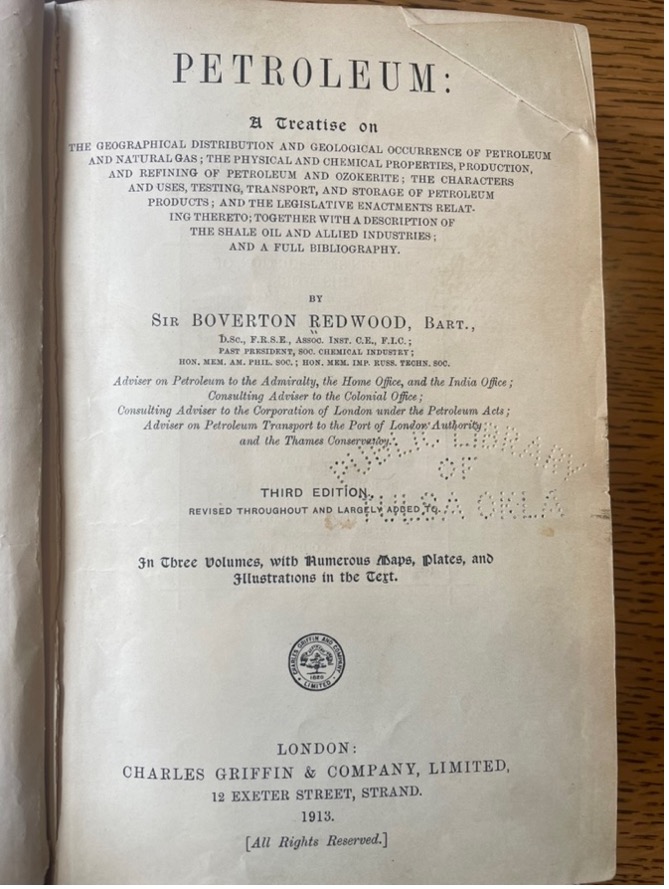
Boverton Redwood’s Petroleum: A Treatise on the Geographical Distribution and Geological Occurrence of Petroleum and Natural Gas (1913) at Linda Hall Library
A serendipitous find at the Linda Hall Library also gave new momentum to my second project that had already begun to take shape alongside my dissertation. While working on the large-scale oil extraction in China’s northwest, I had become increasingly interested in the other face of the coin—the alternative energy in the rural areas. I thus begin to explore how Maoist China pursued technological modernization in the fossil-fuel scarce rural areas where energy production remained decentralized, labor-intensive, and closely tied to local resources. At Linda Hall, I came across A Chinese Biogas Manual: Popularizing Technology in the Countryside, whose combination of technical knowledge, organizational methods, and popularization strategies offered an unusually systematic entry point into this emerging project, tentatively entitled Biomass Revolutionaries. The project examines biomass practices such as methane, charcoal, and animal waste and asks how they reconciled the technocratic pursuit of labor-saving mechanization with the Maoist imperative of mass mobilization.
Together, these research trips supported by the Consortium have substantially expanded the source base of my dissertation, allowing me to approach China’s energy politics through both transnational cooperation and the geological expertise underlying oil exploration. They have also paved the way for my future research on decentralized energy practices in socialist China. I am deeply grateful to the Consortium for making these research opportunities possible.
