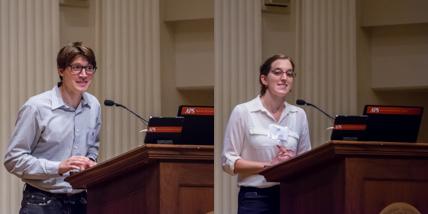
Adam Fertig is a PhD Candidate in American Studies at New York University and a 2026-2027 Consortium Research Fellow.
This summer, funding from the Consortium for History of Science, Technology, and Medicine enabled me to conduct archival research at the Smithsonian Institution and Princeton University. I originally set out to trace how archaeology became a part of development planning, first in the United States and then internationally, from the end of the New Deal to the 1990s. How and why did archaeological surveys become a prerequisite for the licensing of infrastructure projects? In what ways did the shift from academic archaeology to development-related work reshape archaeological practice? And how has archaeological expertise, in turn, affected the terms on which development is legitimized, regulated, and contested? Over the course of my summer research, I both pursued these questions and discovered new ones about the relationship between development and scientific knowledge more broadly.
At the Smithsonian’s National Anthropological Archives (NAA), I consulted the records of a set of twentieth-century American archaeological actors and organizations, including the American Society for Conservation Archaeology (ASCA) and the Fredrick Johnson papers on the Committee for the Recovery of Archaeological Remains (CRAR). CRAR was formed in response to the destruction of archaeological sites brought on by post-World War II federal public works. Most famously, the committee conducted the River Basin Surveys, a foundational salvage archaeology program that excavated sites slated for flooding by dams. In Johnson’s personal papers and exchanges with other CRAR members, what stood out to me was his insistence that archaeologists ought to “hit the resource angle”; that is, frame archaeological artifacts as a kind of resource to be regulated and conserved on the same plane as natural resources. While this language of “cultural resource management” would flourish amongst contract archaeologists in the 1970s, Johnson’s mobilization of the idea in the mid-1950s is a striking prelude. The ASCA memos and letters to membership I reviewed, meanwhile, expressed anxieties about the direction of the field: would working on government projects alongside other scientists and engineers ultimately promote archaeological knowledge and protect sites, or leave archaeology subordinated to political whims and economic fluctuations?
This would turn out to be a perennial question in the history of development-related archaeology, as seen in publications in the field throughout the 1970s and 1980s held at Princeton. The proceedings of the 1984 New World Conference on Rescue Archaeology, for instance, document antagonism between archaeologists and their engineering and planning counterparts, who “viewed archaeologists as totally unreasonable individuals who would force little old ladies to live in tents rather than allow houses to be built for them because someone had once reported to a museum that a stone ax had been found in the general area 50 years ago.” Yet archaeologists and engineers also found common cause at these conferences; as many saw it, in order for the archaeological discipline to survive diminishing university support, it needed to transformed a professional industry and a profitable business. Indeed, by the late 1970s, this process was well on its way, as large architecture and engineering (A&E) firms began offering archaeological surveys as one among many consulting services. This had profound ramifications for the terms of archaeological knowledge production. As one contributor to the 1979 publication Scholars as Contractors put it, “through the A&E firm, archeology is competing in a “high technology” market. Ideas are not viewed as life-long study concepts to be molded, cherished, and refined through an academic career. They are tools like mag cards and varitypers used to get jobs and to get jobs done.”
Consulting materials at the Smithsonian’s National Museum of the American Indian added another dimension to the postwar entanglement of archaeology and federally supported projects: the role of Native American groups who could lay claim to a large portion of artifacts endangered by development. In subject files and correspondence between key actors at the National Congress of American Indians (NCAI), it became evident that archaeology and its relationship to federal development projects was a salient issue for this major Native advocacy organization since at least the 1970s. The NCAI organized campaigns and exchanged often contentious correspondence with federal officials during the uncertain rollout of historic preservation laws. An interesting discovery was that the NCAI dispatched observers to federal heritage consultation hearings for development projects, recording testimony like that of a Colville meeting participant who opposed the Coulee Dam on the grounds that they did not want to “to see [the] bones of [their] ancestors rolling down the river.” Drawing on these experiences, NCAI members synthesized a powerful legal argument that tethered the archaeological remains to Native territorial sovereignty more broadly.
In this vein, the Association on American Indian Affairs (AAIA) papers at Princeton’s Mudd Manuscript Library also turned out to be very relevant, particularly for understanding the emergence of greater Native consultation in development-related archaeological projects during the 1980s and 1990s. Consultation often emerged through struggles to protect specific sites like Bighorn National Forest’s Medicine Mountain. AAIA leaders like the attorney Jack Trope developed new legal strategies through these local struggles, reframing the terms of cultural heritage protection; as Trope emphasized in a letter to Bureau of Land Management officials, “for many American Indians their cultural sites are not "archaeological resources.” Through these infrastructures of advocacy, national Native groups mobilized (albeit with different philosophies and approaches) to redefine and fuse scientific framings of archaeological remains as “cultural resources” into a more expansive defense of both the buried past and contemporary practices under the banner of religious freedom. Along the way, these groups often forged common cause with archaeologists themselves; while in many cases this relationship remained contentious, some government-employed archaeologists came to defend Native sovereignty against the actions of federal land-management agencies from within.
Working across these collections, I began to reconstruct a multifaceted history of development-related archaeology. As I continued to conduct research this summer, however, my findings led me to adjust the framing of the project somewhat. I began to see how archaeological surveys were being leveraged by different actors as one form of technical expertise among many. And while I had set out to examine archaeology in the U.S. and through American-led development organizations like the World Bank, I kept coming across archival material that spoke to an enduring research interest of mine: U.S.-Brazil relations. I became interested in the transnational network of not only archaeologists, but also anthropologists, ecologists, activists, consultants, and businessmen working across the United States and Brazil—particularly the Brazilian Amazon. How did the Amazon become a site of both runaway international investment and international concern by the end of the twentieth century? And how was this transformation mediated by the work of scientific and technical “experts” working both to license and to oppose large-scale development projects?
The leveraging of archaeology in this context became evident as I worked at the NAA with the papers of Clifford Evans and Betty Meggers, an archaeologist couple that worked extensively in Brazil during the second half of the twentieth century. While Megger and Evans largely operated through joint programs of the Smithsonian and the Brazilian government, prior to the era of private- sector archaeological consulting, their work provides relevant context for how archaeology both legitimized and contested megaprojects during Brazil’s military dictatorship. In their correspondence and writings, Meggers and Evans drew on archaeological evidence in the Brazilian Amazon to argue that the region was incapable of supporting the large-scale agricultural schemes proposed by the government and the World Bank; at the same time, I learned that the pair assisted the ecologist Robert Goodland in preparing the socioenvironmental impact report for the contentious Tucurui Dam, asserting that its construction would not destroy buried material culture.
The papers at the NAA of Terence Turner, an activist anthropologist working with Amazonian Kayapó communities, also proved to be instructive here. Turner facilitated the emergence of an international movement opposed to dams and other large development projects: he organized multiple trips where Kayapó activists spoke on U.S. college campuses, met with legislators and World Bank officials in Washington, and visited a Cree reservation in Canada to share dam-blocking strategies. The documents I consulted suggest that actors like Turner, the anthropologist Waud Kracke (whose papers I also consulted at the NAA), and the groups they were a part of—the Environmental Defense Fund, Cultural Survival, and Survival International, among others—used anthropological knowledge to foment opposition to Brazilian development projects, and in so doing fostered an enduring rhetorical defense of pan-Indigenous environmental stewardship.
At the same time, social science and ecology were mobilized to legitimize these same development projects. Some longtime anti-development Brazilianists like the anthropologist Shelton Davis would go on to become World Bank officials, attempting to redirect their cultural expertise towards reforming the Bank’s maligned lending policies. The role of development consultants builds on a longer history that I began examining near the end of the summer, as consulted the papers of David Lilienthal at Princeton. A veteran Tennessee Valley Authority administrator, Lilienthal would go on to pursue dam-building projects internationally through his company, the Development and Resources Corporation. His lesser-known later work on dams in the Brazilian Amazon in the late 1970s indexes how U.S. development actors frequently operated as private-sector consultants rather than through the better-known channels of government aid.
I believe that reframing my research in this way both builds on my initial work on archaeology and hones its relevance. Understanding the deployment of technical expertise provides much-needed context for ongoing struggles over the Brazilian Amazon, where rampant deforestation for agriculture, informal gold mining, and accelerating exploration of new mining and oil drilling operations is being resisted by a range of local and international movements. At last year’s COP30 climate conference in Belem, we saw the performance of a new “common sense” of sustainable development goals—and the Munduruku protests that briefly shut down the conference to demand Indigenous land sovereignty, in the Amazon and worldwide. My research sheds light on how these conceptual imaginaries and strategies have been shaped over prior decades by U.S. actors wielding the tools of social and environmental science.
In short, Consortium support enabled me to refine the direction of my dissertation, leading me to what I believe will be a more sophisticated contribution to the history of science and technology. Funding also allowed me to make substantive progress on archival research in service of this project. During the 2026-2027 academic year, I am conducting research in Brazil on the “other side” of this history; upon my return to the U.S., I plan to return to the collections at the Smithsonian and Princeton to continue building on findings from this summer