Image
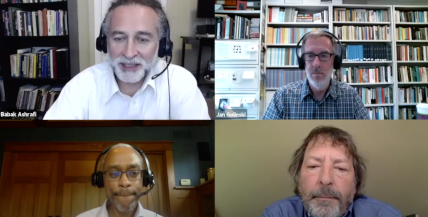
Babak Ashrafi, Jan Golinski, Keith Wailoo, and Tom Misa at the Presidents of AAHM, HSS, and SHOT event. Held online on September 14, 2020.

Princeton University
Nature in the Balance: Ecology, Empire, and the End of Equilibrium
This dissertation proposes a new narrative for twentieth-century environmental thought by reconstructing the rise of a “nonequilibrium paradigm” that challenged the possibility of general ecological theory and the stable and balanced conception of nature it presupposed. Through a series of case studies, the project examines the consequences of this now-dominant position for international environmental governance, decolonial politics, and naturalistic ethics. I identify a key driver of the emergence of nonequilibrium ecology in a pattern of policy failures associated with attempts to operationalize ecological knowledge in environmental management policies. I argue that, over the course of the twentieth century, nonequilibrium ecology developed into a framework for globalizing ecological knowledge according to divergent visions of post-imperial international order, advancing, for some, the economic priorities of hegemonic states and, for others, anticolonial calls for epistemological pluralism and local environmental autonomy. Of broader historiographic significance, the project seeks to bridge conversations in the history of science, environmental history, and international political history, contribute to historical understandings of the spatial politics of science, and use historical analysis to foster productive dialogue on the ethical and political stakes of live scientific questions.
Babak Ashrafi, Jan Golinski, Keith Wailoo, and Tom Misa at the Presidents of AAHM, HSS, and SHOT event. Held online on September 14, 2020.
© 2026 Consortium for History of Science, Technology and Medicine | Copyright Infringement