The Pennsylvania Hospital, Philadelphia, will host its seventh annual History of Women’s Health Conference on Wednesday, April 18, 2012. They would like to invite interested persons to send a one to two page proposal or abstract of your topic by Friday, November 11, 2011 for consideration. The History of Women’s Health Conference focuses on women’s health issues from the late 18th century to the present. This conference encourages interdisciplinary work.
The Center offers one- or two- month Dissertation Research Fellowships and nine-month Dissertation Writing Fellowships for students in the history of science, technology and medicine. More information and online application here.
Amanda Bevers, University of California, San Diego
2011 to 2012 Research Fellow
The Barbara Bates Center for The Study of the History of Nursing would like to announce a new round of fellowships and research awards. For infomation about applying for a Bates Center Fellowship please visit the Bates Center website.
The Center offers both short- and long-term fellowships, as do several members of our consortium. Here is a partial list of scholars—most of whom are graduate students—who have received fellowships from the Center and its consortium partners to study history of science, technology or medicine during the current academic year, 2011-2012.
Rima Apple
University of Pennsylvania (School of Nursing) Lillian Sholtis Brunner Fellowship
Negotiating Public Health: A Study of the Lives of Public Health Nurses.
The Philadelphia Area Center for History of Science holds an annual competition for conferences and workshops on the history of science, technology, and medicine. A typical meeting that would be appropriate for this competition would last not more than two days and involve not more than about fifteen speakers. Applications must be submitted by August 19, 2011.
Philadelphia's first city-wide science festival was the occasion for several news items of interest:
The Center has awarded ten fellowships for dissertation research in area archives and libraries, as well as two fellowships for dissertation writing. Dissertation Research Fellows will spend one or two months conducting research in the Philadelphia area. Dissertation Writing Fellows will spend nine months in residence at the Center and will present their work for the Regional Colloquium in the History of Science, Technology and Medicine.
DISSERTATION RESEARCH FELLOWS
for 2010-2011
Cameron Strang, University of Texas at Austin
2010 to 2011 Research Fellow
Image
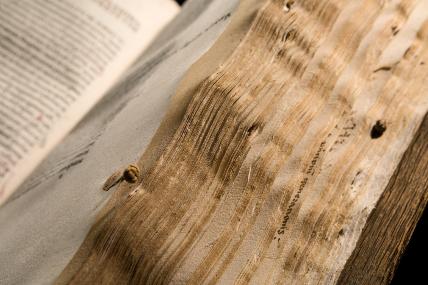
Aristotle, De animalibus (Venice, 1476)