Christopher Jones, University of Pennsylvania
2008 to 2009 Research Fellow
Christopher Jones, University of Pennsylvania
2008 to 2009 Research Fellow
Tina Kibbe, State University of New York at Buffalo
2008 to 2009 Research Fellow
Matthew Laubacher, Arizona State University
2008 to 2009 Research Fellow
Miranda Paton, Cornell University
2007 to 2008 Research Fellow
The Center invites applications for one- or two-month Dissertation Research Fellowships and nine-month Dissertation Writing Fellowships. The application deadline is 11 February 2009. See www.pachs.net/fellowships for more information and for online application form.
Sarah Bridger Columbia University My dissertation covers the political arguments among scientists about Cold War weapons, scientists’ advice to politicians and military planners, and the personal ethical concerns of scientists engaged in research with potential weapons applications. A PACHS Dissertation Research Fellowship in the fall of 2008 supported my research on this topic at three PACHS member institutions, Princeton University, the Chemical Heritage Foundation, and the American Philosophical Society.
Nicholas Spicher Johns Hopkins University There was only one functioning college in British North America at the turn of the 18th century. By the American Revolution, eight more had been founded, and several more were chartered by 1800. What did these colleges teach? Who were the instructors, and on what sources did they base their teaching? What methods did they use? Until recently, many historians have assumed that the colonial colleges were intellectual backwaters whose only purpose was to train future clergy in the bare essentials of classical grammar.
Eric S. Hintz
University of Pennsylvania
Terry M. Christensen Oregon State University John Archibald Wheeler (1911–2008) was among the giants of 20th-century physics. Even so, Wheeler’s many contributions to the corpus of physics are, in my view, overshadowed by his contributions to the community of physicists. Here it is useful to bear in mind that knowledge is cumulative in nature. Today’s breakthrough is tomorrow’s building block, upon which future discoveries will be predicated. A proficient mentor, by contrast, may well have a multiplicative influence on generations of physicists.
Image
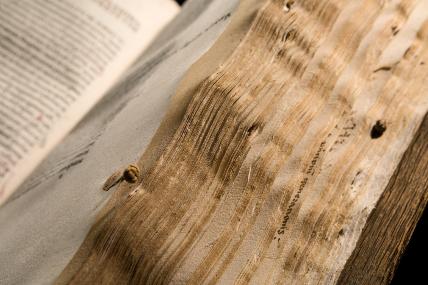
Aristotle, De animalibus (Venice, 1476)