Salem Elzway brings together labor history, political economy, and Science and Technology Studies to examine the history of automation in postwar America. His research traces how political and economic institutions shaped the development and use of industrial robots, from their place in labor-management relations to their role in the production and reproduction of racial difference. Drawing on extensive archival research, he connects the history of robotics to the military-industrial-academic complex, the early development of artificial intelligence, and debates over unemployment and inequality.
Richard Barney
Richard Barney asks how alchemy survived the Enlightenment to influence British literature, aesthetics, and political thought. Discover how Enlightenment writers and satirists like Joseph Addison, Edmund Burke, and Mary Wollstonecraft adapted alchemical techniques like sublimation and distillation—from Isaac Newton's laboratory experiments to James Gillray's political cartoons of Prime Minister William Pitt.
John Sullivan
John Sullivan asks, how did eighteenth-century people understand earthquakes before modern seismology? “Fractious Knowledge” examines how disasters in Italy and Guatemala brought European experts into contact with local builders, artisans, and environmental knowledge. It also shows how global networks of empire pushed natural philosophers to imagine earthquakes on an increasingly planetary scale. Early modern earthquakes shook the foundations of classical science.
Emma Day
Emma Day explores how reproductive expectations shaped women’s healthcare in the United States. Her research reveals how medicine often linked women’s health to reproduction, while also examining the growing recognition of women’s health beyond pregnancy.
Jingwen Li
Jingwen Li uses Consortium collections to explore how ocular impairment was observed, diagnosed, and communicated in transpacific clinics from 1830 to 1930, revealing the challenges of representing vision and visual disability across medical traditions and cultural contexts.
Julia Cummiskey
Julia Cummiskey explores how public policy, corporate enterprise, and visual media shaped health messaging across the continent.
Nancy Campbell
Nancy D. Campbell traces how rural Pennsylvania’s energy landscape evolved from anthracite coal to nuclear power—and now to a massive data-center boom. Her research reveals how decades of corporate consolidation, financial speculation, and energy development are reshaping Salem Township, its land, and its communities.
Jos Alberto Nochebuena
José Alberto Nochebuena uncovers the transnational history of soil mechanics and its transformative role in shaping modern Mexico City.
Clare Byers
Clare Byers examines how eighteenth-century books circulated and reshaped knowledge about North America, revealing how readers used, corrected, and repurposed older information to make new knowledge.
Jonathan MacDonald
Jonathan MacDonald explores how postwar American social scientists used popular media to bring social science to broad audiences and shaped public understanding of democracy, psychology, and civic life.
Olivia Casey
Olivia Casey uses Consortium member collections to show how mid-twentieth-century economists and demographers complicated prevailing ideas tying girls' education to fertility control.
William Krause
William Krause explores how the concept of individual genius shaped U.S. culture, industry and academics in the twentieth century.
Elizabeth Maher
Elizabeth Maher examines the gendered and racialized bifurcation of psychological diagnoses, and the historical roots of autism’s association with white masculinity and technocracy.
Nathalia Gomes
Nathalia Gomes uses Consortium member collections to explore the layers of local and global agency in one of the world's largest disease eradication programs.
Alexey Golubev
Alexey Golubev uses Consortium collections to explore state-sponsored efforts to promote scientific citizenship.
Samantha Muka
Samantha Muka explores the history and politics of waste management in coastal environments.
Katherine White
Katherine White uses rare editions of early modern books in Consortium collections to trace different sources of medical knowledge in the Spanish Empire.
Robert Hancock
Robert Hancock uses Consortium collections to uncover the role that indigenous scholars played in developing the field.
Yovanna Pineda
Yovana Pineda examines the endurance of Juan Perón's regime on Argentina's built environment.
Kristy Bowers
Kristy Wilson Bowers explores the variability and utility of naming historical diseases.
Image
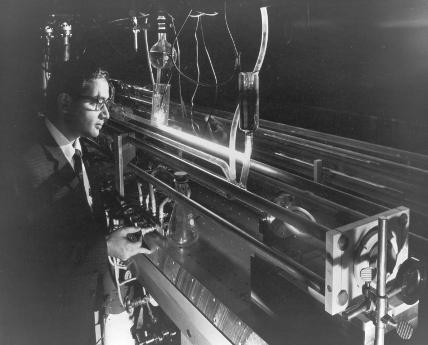
C.K.N. Patel with his experimental 'flowing gas' laser. The glowing tube contains nitrogen in which electrical discharge is taking place.